In short
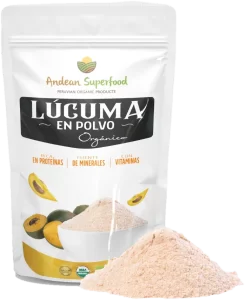
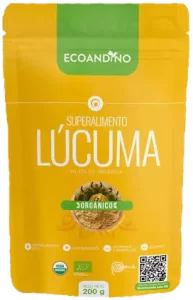
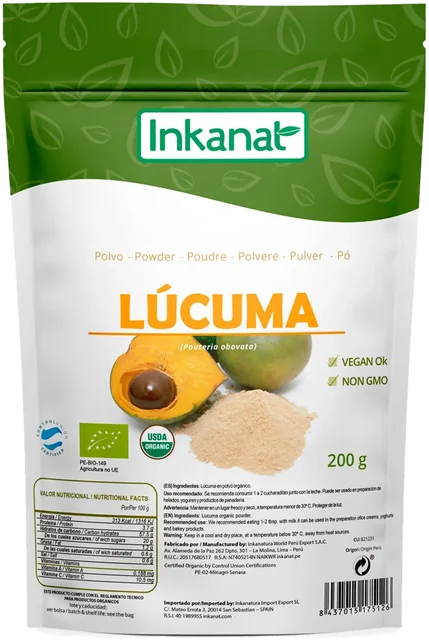
Pure lucuma powder 200g is 100% dehydrated lucuma with no preservatives, artificial flavorings or colorings, bought directly from Andean farmers and Amazonian communities, as stated by the producer. The producer’s suggested serving is 15 g a day, about one and a half tablespoons, so a 200 g pack lasts about two weeks at that amount.
What is pure lucuma powder?
Lucuma (Pouteria lucuma) is an Andean fruit whose dense golden flesh is dried and milled into a fine powder. “Pure” here means one ingredient: dehydrated lucuma fruit, with nothing added to preserve it, color it or flavor it.
That’s worth checking, because fruit powders are among the more commonly bulked-out products in the category. Maltodextrin as a bulking agent and drying aid is widespread, and it can make up a large share of the bag without being obvious on the front label.
What makes this lucuma different
A stated serving
15 g, about one and a half tablespoons. Most fruit powders say nothing about how much to use, which leaves people either using so little they can’t taste it or treating it like flour.
Direct sourcing
Purchased directly from Andean farmers and Amazonian communities rather than through intermediaries, according to the producer: a shorter chain and a documented first mile.
Explicitly free of the usual additions
No preservatives, no artificial flavorings, no colorings. For an orange fruit powder, the coloring point isn’t trivial.
Taste profile
Sweet with a distinctly maple-caramel character and a slightly rough, granular texture, a natural result of dehydrating a dense, starchy fruit. It blends smoothly once liquid hits it.
How to use it
Daily serving
15 g (1½ tablespoons) a day, the producer’s suggested serving, about 50 kcal. A 200 g pack gives about 13 servings at 15 g, or 20 at 10 g.
Ways to use it
| Use | How |
|---|---|
| Smoothies | 15 g with banana and milk |
| Milk drink | 15 g whisked into warm milk |
| Porridge | Stirred in after cooking |
| Yogurt | Folded in |
| Ice cream | 30–40 g per liter |
| Baking | 10–15% of the flour weight |
Where it comes from
Inkanat, a Peruvian brand, states that it buys its lucuma directly from Andean farmers and Amazonian communities. Lucuma grows in the inter-Andean valleys at roughly 1,000–2,400 meters.
Who it’s for
A good fit if you want a stated serving and a one-ingredient label, or care about direct sourcing from growers.
Look elsewhere if you need a large pack: at 15 g a day, 200 g lasts under two weeks. Lucuma is a dried fruit and mostly carbohydrate, about 82 g per 100 g.
Nutrition
Reference values for lucuma powder, per 100 g. The label on the pack may differ slightly.
| Energy | About 330 kcal |
|---|---|
| Carbohydrate | About 82 g |
| of which fiber | About 2.3 g |
| Protein | About 4 g |
| Fat | About 1 g |
| Potassium | About 970 mg |
| Calcium | About 61 mg |
| Niacin (B3) | About 3.3 mg |
| Beta-carotene | Present |
Specifications
| Botanical name | Pouteria lucuma |
|---|---|
| Ingredients | 100% dehydrated lucuma |
| Additives | None |
| Preservatives | None |
| Colorings / flavorings | None |
| Net weight | 200 g / 7 oz |
| Suggested serving | 15 g |
| Sourcing | Direct from growers |
What else can end up in a fruit powder
| Why it’s added | How to spot it | |
|---|---|---|
| Maltodextrin | Drying aid, bulking | Listed second; the powder tastes bland |
| Rice flour | Anti-caking, bulking | Chalky texture |
| Silicon dioxide | Anti-caking | Listed as silicon dioxide or E551 |
| Coloring | Restores faded color | Unnaturally uniform orange |
| Added sugar | Boosts sweetness | Sugar in the ingredient list |
| Nothing | Not needed | One-line ingredient list |
Storage
Keep it airtight, cool, dry and dark. Lucuma powder absorbs moisture and clumps in humid air.
Questions
How much lucuma powder should I use a day?
This producer suggests 15 g, about one and a half tablespoons. Many people use 10 g, which is also perfectly reasonable. There’s no fixed amount; it’s a fruit.
What is maltodextrin and why does it matter in fruit powders?
A cheap starch-derived carbohydrate used as a drying aid and bulking agent. It’s a permitted food ingredient, but it dilutes the fruit: a powder that’s half maltodextrin gives you half the fruit you thought you were buying.
Does lucuma powder have a rough texture?
Slightly, yes. Lucuma flesh is dense and starchy, so the powder is a little granular compared with a spray-dried fruit powder. It smooths out completely once it hits liquid.
How much niacin (vitamin B3) is in lucuma powder?
Reference values put it at about 3.3 mg per 100 g, so about 0.5 mg in a 15 g serving. The label on the pack may differ slightly.
How long does 200 g last?
About 13 days at the suggested 15 g serving, or 20 days at 10 g.
What does “direct from growers” mean?
That the producer buys from farmers rather than through bulk intermediaries. It shortens the chain and usually means a better price at the farm gate.
Can I use lucuma every day?
Yes. It’s a fruit, and it’s eaten daily in Peru. It’s also about 330 kcal per 100 g, so a measured serving rather than a scoopful makes sense.