What is maca powder?
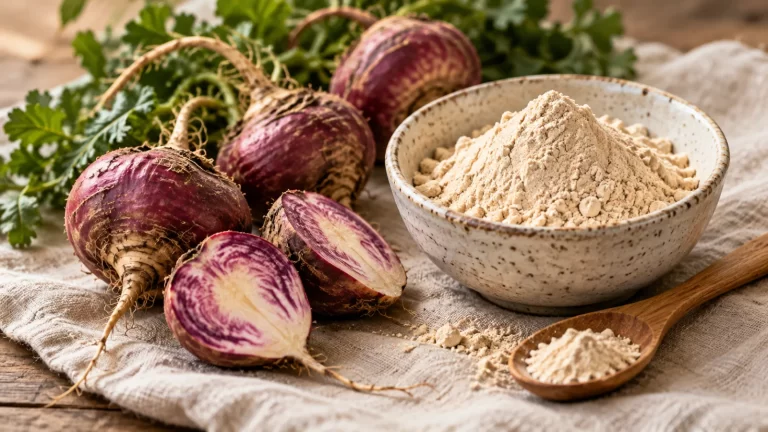
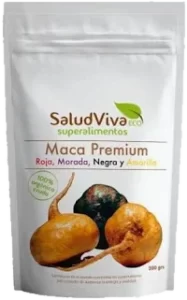
Maca (Lepidium meyenii) is a root vegetable from the same family as radish and turnip. It grows on the high plateaus of Junín and Pasco in central Peru, between 3,800 and 4,500 meters, where the nights freeze for much of the year and few other crops survive.
The roots come in several colors. Yellow is by far the most common, so a pack labeled simply “maca” is usually yellow maca. The roots are dried, then milled into a fine, pale powder. In the Andes, maca is eaten as food: boiled, roasted or blended into warm, sweet drinks.
| Plant | Maca, Lepidium meyenii, a relative of radish and turnip |
|---|---|
| Where it grows | Central Andes of Peru, mostly Junín and Pasco |
| Altitude | 3,800 to 4,500 meters |
| Colors | Yellow (the most common), plus red, black and others |
| Taste | Malty and nutty, with a butterscotch finish |
| Caffeine | None |
| Serving | Start with 1 teaspoon (about 3 g) a day; follow the pack |
| Gluten | Naturally gluten free; check the pack if you need a certified product |
| Keeps | A year or more sealed; see the best-before date |
How maca tastes
Maca powder tastes malty and nutty, a little like butterscotch or malted milk. Raw powder has an earthy, slightly vegetal edge; gelatinized powder is milder and toastier. Yellow is the mildest of the colors, which makes it the easiest place to start.
Want something stronger? Black maca is the earthiest color. Red maca is a little sweeter.
How to use maca powder
Stir it into food and drinks. Start with one teaspoon (about 3 g) a day and follow the serving printed on the pack.
| Use | How much | Good to know |
|---|---|---|
| Smoothies | 1 teaspoon per glass | Goes well with banana, dates and cacao |
| Coffee and lattes | 1 teaspoon per cup | Whisk it into a little warm milk first |
| Oatmeal and yogurt | 1 teaspoon per bowl | Stir it in after cooking |
| Hot chocolate | 1 teaspoon per mug | With cacao powder and warm milk |
| Baking | 1 to 2 tablespoons per batch | Brownies, cookies, pancakes, energy balls |
Tip: maca clumps in hot liquids. Whisk it into a spoonful of warm milk first, then top up the cup.
Does maca have caffeine?
No. Maca is a root vegetable, not a coffee or tea plant, and it contains no caffeine. Some people stir it into decaf coffee or drink it in the afternoon for that reason. If you add it to regular coffee, the caffeine in the cup comes from the coffee.
Raw or gelatinized maca powder?
Raw maca is dried and milled. Gelatinized maca is cooked under pressure first, which breaks down much of its starch, then dried and milled. Gelatinized powder tastes milder, mixes more smoothly, and some people find it easier to digest. Raw powder keeps a stronger, earthier taste. Each product page says raw or gelatinized when the pack does.
How to choose maca powder
- Organic: organic maca powder carries a certification seal, such as USDA Organic or EU Organic. We list it exactly as it’s printed on the pack.
- Origin: look for “Product of Peru” on the label. Some packs also name the region.
- Raw or gelatinized: gelatinized if you want a milder taste and smoother drinks; raw for baking and smoothies.
- Color: yellow for a mild taste, black for a stronger one, red for a sweeter one. Some packs blend several colors.
- Pack size: at one teaspoon a day, a 250 g pack lasts almost three months.
- Sealed and in date: we check the seal and the best-before date on every pack before it leaves Lima.
Maca benefits: what we can and can’t say
Maca is often sold with promises about energy, hormones, libido and fertility. We don’t make them. Here’s what we can say:
- In the Andes, maca is a traditional food that families have eaten for generations.
- Studies in people are few and small. Systematic reviews found too little evidence to draw firm conclusions about maca and sexual function1 or menopause symptoms.2
- That research doesn’t show that maca treats or prevents any condition.
There isn’t enough research on maca during pregnancy or breastfeeding. If that’s you, or you have a thyroid condition or take medication, talk to your doctor before taking it.
Sources
- Shin BC, Lee MS, Yang EJ, Lim HS, Ernst E. Maca (L. meyenii) for improving sexual function: a systematic review. BMC Complementary and Alternative Medicine. 2010;10:44. doi:10.1186/1472-6882-10-44
- Lee MS, Shin BC, Yang EJ, Lim HJ, Ernst E. Maca (Lepidium meyenii) for treatment of menopausal symptoms: a systematic review. Maturitas. 2011;70(3):227–233. doi:10.1016/j.maturitas.2011.07.017