The short answer
Black maca vs maca comes down to root color. Both are Lepidium meyenii, and plain “maca” is usually yellow maca, the most common color. In rat and mouse studies, black maca had more effect on sperm production and on a learning test. No study has compared black and yellow maca in people, so neither is proven better.
Black maca vs maca at a glance
Yellow vs black maca, side by side. The chemistry figures come from two analyses of maca grown in China, and every effect listed was measured in animals, not people.
| Black maca | Yellow (“regular”) maca | |
|---|---|---|
| Plant | Lepidium meyenii | Lepidium meyenii |
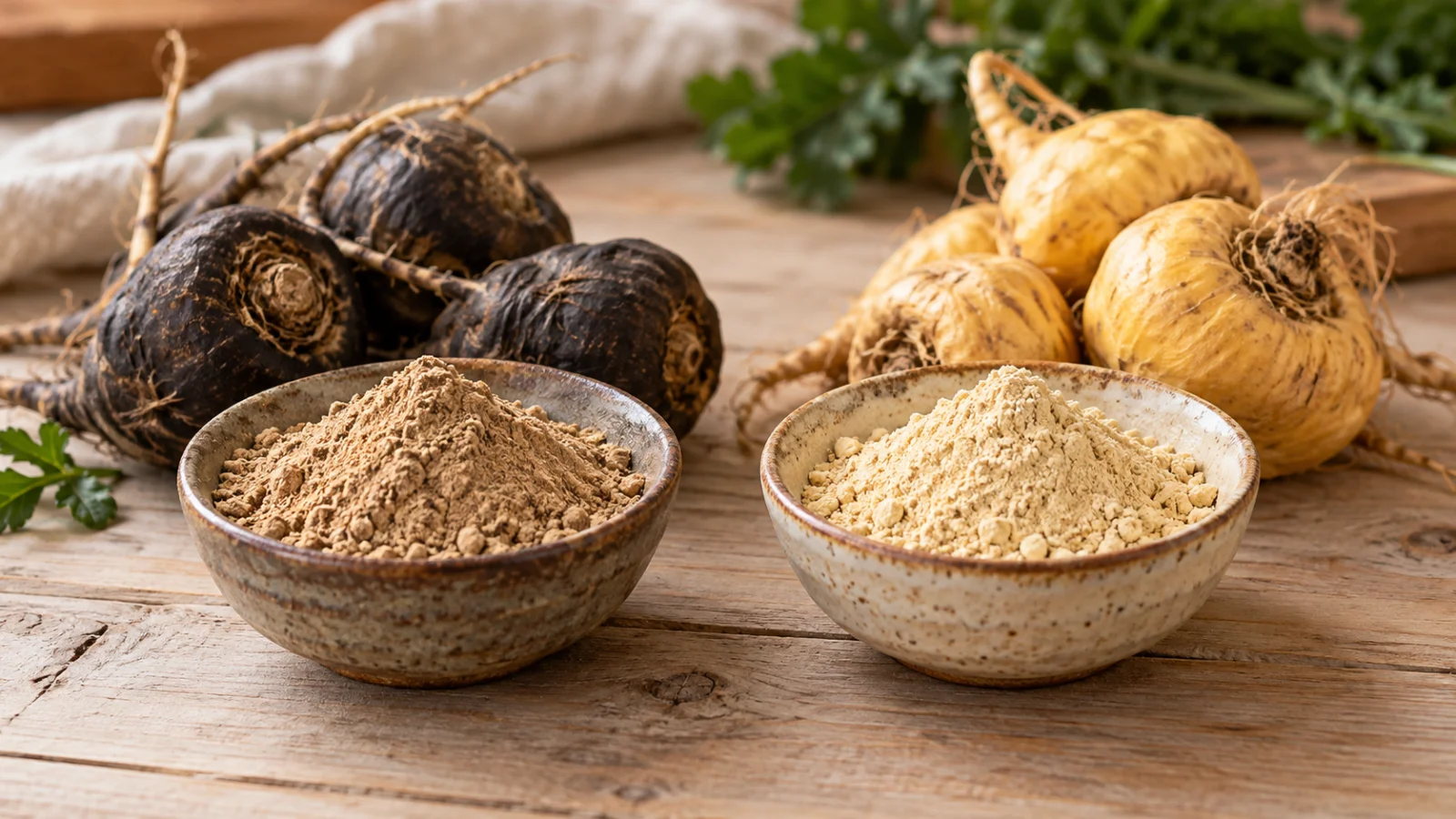
| Root skin | Black to dark gray-purple | Yellow to cream |
| How common | Less common | The most common color |
| Glucosinolates (one analysis) | 1.55%, tied for highest | 1.55%, tied for highest |
| Macamides (one analysis) | 0.15%, lowest of the colors | Higher than black |
| Main nutrient difference (one analysis) | Richer in protein | Higher in carbohydrates |
| Animal studies | Sperm production, a learning test, bone protection | Sperm counts in a long rat study; a mouse mood test; no bone effect |
| Head-to-head trial in people | None | None |
| Forms sold | Raw or gelatinized powder, capsules | Raw or gelatinized powder, capsules |
Sources: Minich 2024; Rubio 2006; Gasco 2007.
Is black maca the same as maca root?
Yes. Black maca and yellow maca are the same species, Lepidium meyenii, a root crop of the high Andes that grows at 3,500 to 5,000 meters in Peru. What changes is the color of the root’s skin. A 2024 review of maca colors counts up to 17 shades; yellow, black and red are the ones researchers study most.
In Carhuamayo, a maca-growing town in Junín, researchers described 13 varieties ranging from white to black, and yellow was both the most frequent and the one buyers preferred (Rubio 2006). That’s why a bag labeled simply “maca,” “Peruvian maca” or “regular maca” usually holds yellow root, or a mix of colors. White maca is another pale shade among those varieties. If the color matters to you, buy a pack that names it, such as yellow maca powder or black.
Key differences between black and yellow maca
So what is the difference between maca and black maca, beyond the color of the skin? Less than marketing suggests, and most of it is still unexplained.
How common each one is
Where researchers have counted, yellow is the most common color. Black is less common. Many sellers quote exact shares of the harvest for each color, but we couldn’t find those figures in any published study, so we won’t repeat them. If black maca costs more, rarity is the likely reason. It isn’t proof that it works better.
Plant compounds and nutrients
The 2024 color review reports these differences, all from studies of maca grown in China:
- Glucosinolates, a group of plant compounds, were highest in yellow and black maca, both at 1.55%.
- Macamides, compounds found only in maca, were lowest in black maca at 0.15%, against 0.23% to 0.29% in the other colors.
- Yellow maca was higher in carbohydrates; black maca was richer in protein.
Growing conditions shift these numbers. The same review notes that maca grown below 3,500 meters tends to have fewer macamides, and that raw maca may hold about 20% more glucosinolates than gelatinized maca. Nobody has shown that any of these differences changes what maca does in your body.
Taste
Sellers often call black maca stronger or earthier than yellow. We found no taste study comparing them, so treat that as an opinion, and try a small amount of each in a smoothie or oatmeal.
What studies found for black vs yellow maca
Is black maca better than yellow maca? The honest answer is that nobody has tested the question in people. The one human trial that compared two colors put black maca against red, not yellow: 175 adults in Peru completed 12 weeks of 3 g a day of black or red maca extract, or a placebo (Gonzales-Arimborgo 2016). The color is also often unknown. Of 30 published maca trials, only half say which color they used, according to the 2024 color review.
Each color has also been tested on its own in men. In two trials listed in a 2024 review of maca research, gelatinized yellow maca made no significant difference to semen compared with placebo, in 13 healthy men and then in 50 men with infertility. A trial of gelatinized black maca in 80 men over 40 improved symptom scores without changing testosterone, according to the 2024 color review. That trial is covered in our look at the black maca research for men and women.
Everything else comes from animals. One caveat: every study of effects by color that we link to here, in animals and in people, comes from one research group in Lima, led by Gustavo F. Gonzales, so the results still need independent confirmation.
Sperm counts (rodent studies)
In animals, black maca has the strongest effect on sperm production, yellow a moderate one and red none, according to the 2024 color review. Over a longer run, the picture is closer: in an 84-day study in male rats, yellow and black maca both raised sperm counts in the epididymis, the duct where sperm is stored, while red did not. None of the three changed daily sperm production in that study.
Learning and mood (a mouse study)
In a 21-day study in female mice with their ovaries removed, black maca gave the best result in trained mice on a simple learning test, finding water, and the authors concluded it had the most benefit for learning. In a swimming test used to screen for antidepressant-like effects, all three colors beat the untreated mice, and yellow did best: the immobility score fell from about 205 in untreated mice to 157 with yellow and 175 with black.
Bone (rat studies)
In rats with their ovaries removed, extracts of black and red maca protected bone at a level close to estradiol, while yellow maca did not, according to the 2024 color review. There are no bone studies of either color in people.
| Outcome | Black | Yellow | Studied in |
|---|---|---|---|
| Sperm production | Strongest effect | Moderate effect | Rodents |
| Sperm count in the epididymis after 84 days | Increased | Increased | Rats |
| Learning test | Best result | Smaller effect | Mice |
| Swimming test (mood model) | Improved | Improved the most | Mice |
| Bone after ovary removal | Protected | No effect | Rats |
| Any outcome, black vs yellow | No trial | No trial | People |
Sources: Minich 2024; Gasco 2007; Rubio 2006.
Black maca or yellow maca: which should you choose?
Because there’s no human study to settle it, the choice is practical, not medical.
- Choose yellow maca if you want the most common, everyday root to add to food, usually at a lower price.
- Choose black maca if you are curious about the color with the most animal research on sperm and learning, knowing that the edge hasn’t been shown in people.
- Choose a mix (“tri-color” or unlabeled maca) if the color doesn’t matter to you.
- Check the pack either way: it should name the color and say whether the powder is raw or gelatinized.
Black maca powder vs regular maca powder is the same comparison: same plant, dried and ground the same way. You’ll find the black maca we bring from Peru on our Peruvian black maca powder page. If you are weighing black against the third common color, see black maca against red maca, and for the remaining pair, how red maca compares with yellow maca.
Raw or gelatinized: does the form matter more than the color?
Which form of maca is best is a fair question, and the evidence is thin there too. Gelatinized maca is heat-treated before it is milled. The 2024 color review says this improves digestibility and that raw maca may keep about 20% more glucosinolates, but we found no study that compared the two forms, in maca of any color, for tolerance or for a health effect.
In the maca we stock, yellow maca comes raw or gelatinized depending on the pack, and black maca includes a gelatinized powder (Ecoandino, 200 g). For a closer look at processing, read gelatinized vs raw maca.
Is black maca safer or stronger than yellow?
We found no evidence that one color is safer than the other. For maca of any color, LiverTox, the NIH’s database on liver injury from drugs and supplements, finds no convincing report of liver damage, and the side effects it lists, mainly digestive complaints and headache, are uncommon and mild. In the 12-week trial, black maca extract caused no serious side effects. The 2024 review of maca research lists rare reports such as one case of vaginal bleeding and one manic episode.
Talk to your doctor before taking maca of any color if you are pregnant, breastfeeding, on medication or managing a health condition. The 2024 review of maca research reports no study in pregnant women; its only pregnancy-safety data come from one study in animals. If you have had a hormone-sensitive cancer, the 2024 color review considers maca contraindicated. Its authors add a pattern seen in their own patients, not tested in a study: some women with polycystic ovary syndrome and high estrogen did worse on products richer in black maca.
Frequently asked questions
Is black maca stronger than yellow maca?
“Stronger” hasn’t been measured in people. In rats and mice, black maca had more effect on sperm production and on a learning test, while yellow did better on a mouse mood test. One analysis of Chinese-grown maca even found fewer macamides in black maca than in the other colors. Strength depends on what you measure.
Which maca is best for men?
No one knows, because no trial has compared colors in men. Small trials of gelatinized yellow maca found no significant change in semen, and a trial of gelatinized black maca in men over 40 improved symptom scores without changing testosterone. They studied different men and different questions, so they can’t be ranked against each other.
Which maca is best for women?
Nobody has tested black against yellow maca in women. The closest data come from female animals with their ovaries removed: in rats, black maca protected bone and yellow did not, and in mice, black did best on a learning test and yellow on a mood test. If you have polycystic ovary syndrome, read the safety notes above first.
What happens if I take black maca every day?
In trials, adults took black maca daily for up to 12 weeks without serious side effects. There’s no long-term data on daily supplements. As a food, dried maca root is eaten in the Andes in amounts above 20 g a day, according to the 2024 color review. That describes a traditional diet, not a supplement amount anyone has tested.
Can you mix black and yellow maca?
Yes. Blends of yellow, black and red maca are widely sold, often as “tri-color” maca. No study has compared a blend with a single color, so a mix comes down to taste and price, not a proven extra effect. The safety notes are the same as for any maca.
Is white or “regular” maca the same as yellow maca?
Not exactly. “Regular” isn’t a color, it’s a sales word, and it usually means yellow maca or a mix. White maca is its own pale shade among the 13 varieties described in Carhuamayo. Read the pack: a good label names the color and says whether the root is raw or gelatinized.
Shop Peruvian black maca powder
Prefer black maca in your smoothies or oatmeal? These are the black maca powders we pick up in Peru, read the label on, and ship to you.
Sources
- Minich DM, Ross K, Frame J, et al., 2024. Not All Maca Is Created Equal: A Review of Colors, Nutrition, Phytochemicals, and Clinical Uses. Nutrients.
- Rubio J, Caldas M, Dávila S, Gasco M, Gonzales GF, 2006. Effect of three different cultivars of Lepidium meyenii (Maca) on learning and depression in ovariectomized mice. BMC Complementary and Alternative Medicine.
- Gasco M, Aguilar J, Gonzales GF, 2007. Effect of chronic treatment with three varieties of Lepidium meyenii (Maca) on reproductive parameters and DNA quantification in adult male rats. Andrologia.
- Gonzales-Arimborgo C, Yupanqui I, Montero E, et al., 2016. Acceptability, Safety, and Efficacy of Oral Administration of Extracts of Black or Red Maca (Lepidium meyenii) in Adult Human Subjects: A Randomized, Double-Blind, Placebo-Controlled Study. Pharmaceuticals.
- Ulloa del Carpio N, Alvarado-Corella D, Quiñones-Laveriano DM, et al., 2024. Exploring the chemical and pharmacological variability of Lepidium meyenii: a comprehensive review of the effects of maca. Frontiers in Pharmacology.
- National Institute of Diabetes and Digestive and Kidney Diseases, 2019. Maca. LiverTox: Clinical and Research Information on Drug-Induced Liver Injury.