What is red maca?
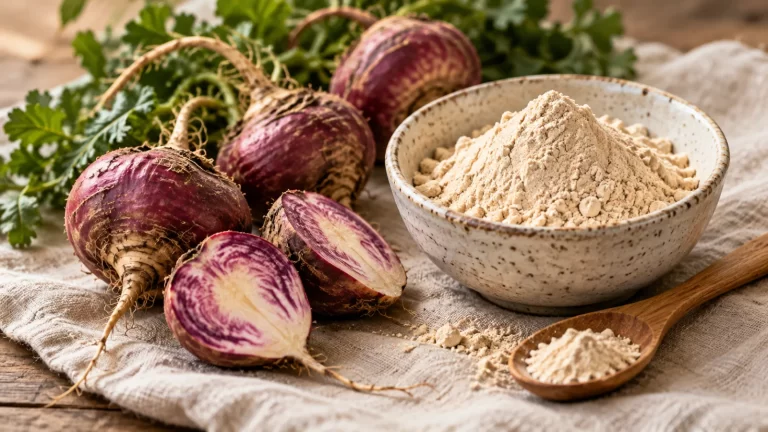
Red maca is maca (Lepidium meyenii) with red to purplish-red skin. It grows in the same fields as yellow and black maca, on the high plateaus of Junín and Pasco in central Peru, between 3,800 and 4,500 meters. Each field gives roots in several colors; producers sort the red ones out of the harvest, dry them and mill them into powder.
Red is a smaller share of each harvest than yellow, which is why red maca usually costs more. It’s also harder to find: in Peru, large supermarkets mostly stock red maca in capsules, and the powder usually comes from health food stores.
| Plant | Maca, Lepidium meyenii, a relative of radish and turnip |
|---|---|
| Root | Red to purplish-red skin |
| Where it grows | Central Andes of Peru, mostly Junín and Pasco |
| Altitude | 3,800 to 4,500 meters |
| Taste | Malty and slightly sweet |
| Forms | Raw or gelatinized powder; also sold in capsules |
| Caffeine | None |
| Serving | Start with 1 teaspoon (about 3 g) a day; follow the pack |
| Keeps | A year or more sealed; see the best-before date |
How red maca tastes
Red maca has the same malty, nutty base as all maca, and it’s usually the sweetest of the three main colors. That makes it a good fit for fruit smoothies, yogurt and oatmeal, where an earthier maca could take over.
How to use red maca powder
Start with one teaspoon (about 3 g) a day and follow the serving printed on the pack.
- Smoothies: with berries, banana or mango; it suits fruit better than black maca does.
- Breakfast: stirred into yogurt, overnight oats or porridge.
- Warm drinks: in a latte or a mug of warm milk with cinnamon.
- Baking: in pancakes, muffins and energy balls.
Tip: maca clumps in hot liquids. Whisk it into a spoonful of warm milk first, then top up the cup.
Red, black or yellow maca?
All three are the same plant. The color changes the taste and the price, not what the root is:
- Red: slightly sweet and less earthy than black. Good in smoothies and yogurt.
- Black: the strongest and earthiest. Good in coffee and cacao drinks.
- Yellow: mild, malty and the least expensive. The easiest place to start.
For a full comparison, read Black maca vs red maca: what’s actually different.
How to choose red maca powder
- Only red maca, or a blend: some packs mix several colors. If you want red maca alone, check the ingredients list.
- Organic: organic red maca powder carries a certification seal, such as USDA Organic or EU Organic; each product page shows it as printed on the pack.
- Raw or gelatinized: gelatinized is milder and mixes more smoothly; raw keeps a stronger taste. Each product page says which when the pack does.
- Origin: look for “Product of Peru” on the label.
- Powder or capsules: powder is for food and drinks; capsules are a supplement format.
Red maca benefits: what we can and can’t say
Red maca is often marketed to women for hormones, menopause and fertility, and to men for prostate health. We don’t make those claims. Here’s what we can say:
- In the Andes, maca is a traditional food eaten by men and women alike.
- Most research on red maca in particular has been done in animals, such as rats.1
- Studies in people are few and small, and most of them test maca in general, not one color. A systematic review of the trials on menopause symptoms found the evidence too limited to draw firm conclusions.2
- That research doesn’t show that red maca treats or prevents any condition.
If you want to take red maca for a health reason, or you’re pregnant, breastfeeding, have a thyroid condition or take medication, talk to your doctor first.
Sources
- Gonzales GF, Miranda S, Nieto J, et al. Red maca (Lepidium meyenii) reduced prostate size in rats. Reproductive Biology and Endocrinology. 2005;3:5. doi:10.1186/1477-7827-3-5
- Lee MS, Shin BC, Yang EJ, Lim HJ, Ernst E. Maca (Lepidium meyenii) for treatment of menopausal symptoms: a systematic review. Maturitas. 2011;70(3):227–233. doi:10.1016/j.maturitas.2011.07.017