The short answer
Red maca root benefits are mostly unproven in people. In a 12-week trial in Peru, 3 g a day of red maca extract improved self-rated mood and energy more than placebo in adults living near sea level, and slightly raised sexual desire in those living at high altitude. Smaller prostates and less bone loss were seen only in rats.
What is red maca good for? The evidence at a glance
Most research on red maca itself was done in animals.
| Claimed benefit | Who was studied | What was found | Strength of evidence |
|---|---|---|---|
| Mood | 175 adults in Peru, 12 weeks, red or black maca extract vs placebo | Better than placebo near sea level; mixed at high altitude | One human trial |
| Energy | Same trial | Better than placebo near sea level; no difference at altitude | One human trial |
| Sexual desire | Same trial, plus other small maca trials in a 2018 review | Small rise at altitude only; evidence limited overall | Weak |
| Chronic mountain sickness | Highland residents in the same trial | Lower symptom score than placebo with red; black no better than placebo | One human trial |
| Menopause symptoms | Small trials in women around menopause | Fewer symptoms in some; red maca not reported | Weak, not specific to red |
| Prostate size | Male rats | Smaller prostate with red; no change with yellow or black | Animals only |
| Bone loss | Female rats with ovaries removed | Red and black protected bone; yellow did not | Animals only |
| Hormone levels | Small human trials | No consistent change | Not shown |
| Female fertility | No trials in women; one study in female rats | No change in the cycle or eggs released | Animals only, no benefit shown |
Sources: Gonzales-Arimborgo 2016, Beharry and Heinrich 2018, Gonzales 2005, Minich 2024, Ulloa del Carpio 2024.
What red maca root is
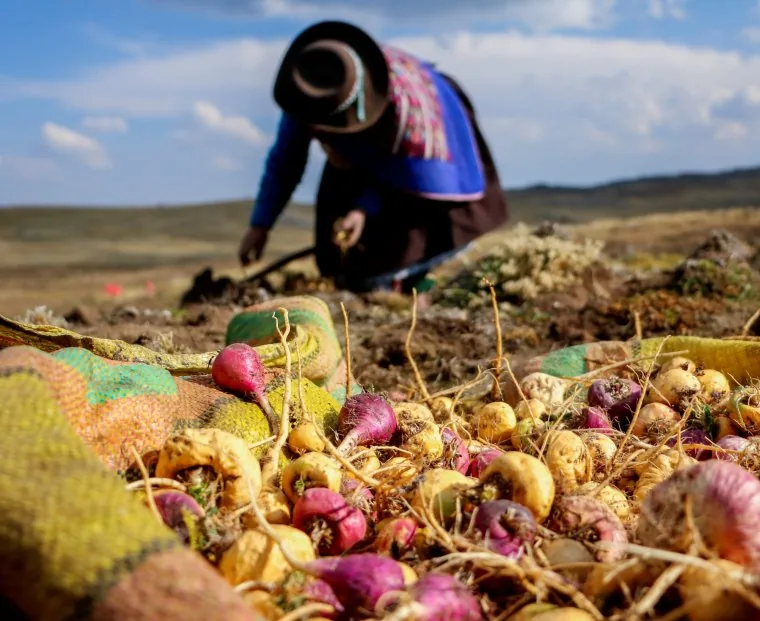
Red maca is not a separate plant. It is Lepidium meyenii, the same Andean root as yellow and black maca, with red to purple skin. A 2024 review of maca colors counts up to 17 root colors and notes that yellow, black and red are the most studied. In Peru the plant grows at 3,500 to 5,000 meters, and highland families eat the dried root as an everyday food.
One Peruvian analysis found more glucosinolates, a group of plant compounds, in red roots from Junín than in three other colors. Nobody has tested what that means for your health. For the plant itself, see how red maca grows and where it comes from.
When we shop for red maca in Peru, finding it as powder is the hard part. The big supermarket chains mostly carry capsules, and 9 of the 10 red maca powders we found came from natural-food stores (tiendas naturistas). People stir red maca powder from Peru into smoothies and oatmeal or add it to baking.
Red maca root benefits seen in people
We found only one randomized trial that tested red maca on its own in people. Researchers in Peru gave adults aged 18 to 65 either 3 g a day of red maca extract, the same amount of black maca extract, or a placebo for 12 weeks, and 175 people finished. Half lived in Lima, near sea level, and half in Cerro de Pasco, at 4,340 meters (Gonzales-Arimborgo 2016).
Two details matter when you read the results. The 3 g was a spray-dried extract: the authors say about 20 g of dried root yields almost 3 g of it, so a spoonful of powder is not the same thing. And the study’s senior author, Gustavo F. Gonzales, manages a small company that makes nutraceuticals, which the paper discloses.
Mood and energy
Near sea level, people on red maca rated their mood better than the placebo group from the first week and their energy better from the second week, and red did better than black on both. At high altitude, energy didn’t differ between groups, and the mood difference had faded by week 12. Mood was a simple five-point rating, not a depression test.
Sexual desire
By week 12, about half of the people on red maca said their desire had gone up. Near sea level, though, neither color beat placebo; only at altitude did red maca score higher than placebo, and the authors called the effect modest. More broadly, a 2018 review of maca’s reproductive claims found the evidence on sexual function limited by weak methods and few participants.
Quality of life and mountain sickness
Both red and black maca improved a general quality-of-life score more than placebo. In the highland group, red maca also lowered the score for chronic mountain sickness, a condition of people who live at high altitude for years, while black maca did no better than placebo.
Red maca benefits for women
What does red maca do for women? We found no trial of red maca in women alone; the Peru trial included both women and men. The studies of maca in women looked at menopause and sex drive, and the color was often missing: in the 2024 color review, only half of 30 maca trials named the color they used.
Menopause symptoms
In a small crossover trial listed in a 2024 review of maca research, 14 postmenopausal women took 3.5 g of maca powder a day. Anxiety, depression and sexual-problem scores improved, but estradiol, FSH and LH did not change. Other small trials with gelatinized maca capsules also reported fewer symptoms. None of them is described as using red maca.
Bone loss after menopause (rat studies)
This is where the “bone density” claim comes from. In rats whose ovaries were removed, a standard model of menopause, extracts of red and black maca protected bone about as well as estradiol, without enlarging the uterus. Yellow maca had no such effect (Minich 2024). We found no study that measured bone density in women taking red maca.
Does red maca balance hormones?
Not on the evidence so far. You may read that red maca lowers “excess estrogen,” but we found no study showing that. The 2024 color review notes that clinical trials lasting weeks or months haven’t shown significant effects on hormones, and the menopause trial above found no change in estradiol.
Red maca benefits for men
Can men take red maca? Men were part of the Peru trial, which reported no serious side effects. Most of the evidence aimed at men, though, comes from rats.
Prostate size (rat studies)
In a 2005 study in rats, red maca extract made the prostate lighter within 7 days, while yellow and black maca did not. In rats whose prostates had been enlarged with testosterone injections, two weeks of red maca brought prostate weight down from 0.29 to 0.23 g per 100 g of body weight, about 20% lower, though still above normal. Red maca did not change the rats’ testosterone or estradiol. We found no trial in men, and the human trial didn’t measure PSA.
Testosterone, sperm and sex drive
In people, maca doesn’t seem to move sex hormones. In a study of 56 adult men who took 1.5 or 3 g of maca a day for up to 12 weeks, summarized by LiverTox, sex and pituitary hormone levels did not change. In animal studies, black maca is the color tied to sperm production, and red had no effect (Minich 2024). For desire, the 2024 review of maca research lists a trial in 57 healthy men who reported more desire on maca than on placebo.
What red maca hasn’t been shown to do
LiverTox, an NIH database, says none of maca’s claimed effects have been proven in rigorous controlled trials in humans. For red maca, there’s no good evidence that it:
- balances hormones or lowers estrogen;
- shrinks the prostate in men;
- raises bone density in women;
- helps women get pregnant;
- changes body weight;
- does anything over the long term, since most trials lasted 12 weeks or less.
How red maca was taken in studies: powder, capsules and extract
Studies have used several forms, and the amounts aren’t interchangeable. This table shows what researchers used; it is not a dosing guide. We go into amounts in how much red maca people take.
| Form | Amount used in the study | Who took it | Maca color |
|---|---|---|---|
| Spray-dried extract | 3 g a day for 12 weeks | 175 adults in Peru | Red or black |
| Powder | 3.5 g a day | 14 postmenopausal women | Not reported |
| Capsules | 1.5 or 3 g a day for 12 weeks | Adults with sexual side effects from antidepressants | Not reported |
| Gelatinized powder | About 5 g a day for 12 weeks | 80 men over 40 with symptoms of low testosterone | Black |
Sources: Gonzales-Arimborgo 2016; Ulloa del Carpio 2024; Minich 2024.
Raw, gelatinized and organic describe how the root was grown or processed, not proven benefits. Raw maca may keep about 20% more glucosinolates than gelatinized (Minich 2024), but no study has compared the two forms of red maca for any health effect. On capsules and pills, check whether the label lists root powder or extract, and how many milligrams.
Red maca side effects and who should avoid it
Maca is usually well tolerated in short trials: in the Peru trial, neither extract caused serious side effects or dropouts. According to LiverTox, side effects are infrequent and usually minor, such as an upset stomach or a headache, and no convincing report ties maca to liver damage.
The 2024 review of maca research adds a few reports: stomach upset, headache and irritability in one trial at 3 g a day; a moderate rise in a liver enzyme and in diastolic blood pressure in a 90-day trial in people with metabolic syndrome; one case of vaginal bleeding; one manic episode; and a possible interaction with the antidepressant mianserin that couldn’t be confirmed.
What to avoid while taking red maca
Skip it, or talk to your doctor first, if you are pregnant or breastfeeding, take prescription medicine, or have a health condition. The 2024 review of maca research reports no study in pregnant women; its only pregnancy-safety data come from one study in animals. The 2024 color review also says maca should not be used by anyone with a history of hormone-sensitive cancer. For more, read red maca side effects in more detail.
Red maca vs black and yellow maca
All three are the same plant. Red maca has the prostate results in rats and edged out black maca for mood and energy in the one human trial; black maca is the color tied to sperm production in animals. The studies of effects by color cited here, in rats and in people, all come from the same research group in Lima, led by Gustavo F. Gonzales, so they still need independent confirmation. For a side-by-side table, see how black and red maca compare.
Frequently asked questions
What happens if I take red maca every day?
In the red maca trial, people took the extract every day for 12 weeks without serious side effects; other maca trials have run for several months. There are no long-term data on daily red maca as a supplement. Highland diets often include more than 20 g of dried root a day (Minich 2024), but a diet is not a supplement trial.
How long does red maca take to work?
In the one red maca trial, mood ratings pulled ahead of placebo after the first week and energy after the second, in people living near sea level. The change in sexual desire appeared only at week 12, and only at high altitude. The research can’t tell you whether you would notice anything.
Is red maca good for you?
As a food, maca is a root eaten in Peru for generations, made up mainly of carbohydrates and protein, according to LiverTox. As a supplement, the evidence for red maca is thin: one human trial with an extract and a few rat studies. It seems well tolerated in short trials, but no health benefit is proven.
Which maca color is best for women?
No trial has compared colors in women. In rats with their ovaries removed, red and black maca protected bone and yellow did not. In the one trial that compared two colors in people, red did slightly better than black for mood and energy. Neither result tells you which color will work for you.
Can red maca help you get pregnant?
We found no trial testing whether red maca helps women conceive. The claim rests on tradition. In female rats, red maca didn’t change the cycle or the number of eggs released (Beharry and Heinrich 2018). The mouse study that found bigger litters used yellow maca, not red; we walk through it, the twins myth and when to stop in what the studies on maca and female fertility show.
Does red maca make you gain weight?
It hasn’t been studied for weight gain. In the 12-week trial, body mass index didn’t differ from placebo with either red or black maca extract. Maca powder adds calories like any food, but there is no evidence that it changes body weight or shape on its own.
Shop Peruvian red maca powder
If you enjoy red maca as an ingredient, here are the red maca powders we find in Peru and send from Lima.
- Out of stock
Sources
- Gonzales-Arimborgo C, Yupanqui I, Montero E, et al., 2016. Acceptability, Safety, and Efficacy of Oral Administration of Extracts of Black or Red Maca (Lepidium meyenii) in Adult Human Subjects: A Randomized, Double-Blind, Placebo-Controlled Study. Pharmaceuticals.
- Beharry S, Heinrich M, 2018. Is the hype around the reproductive health claims of maca (Lepidium meyenii Walp.) justified? Journal of Ethnopharmacology.
- Gonzales GF, Miranda S, Nieto J, et al., 2005. Red maca (Lepidium meyenii) reduced prostate size in rats. Reproductive Biology and Endocrinology.
- Minich DM, Ross K, Frame J, et al., 2024. Not All Maca Is Created Equal: A Review of Colors, Nutrition, Phytochemicals, and Clinical Uses. Nutrients.
- Ulloa del Carpio N, Alvarado-Corella D, Quiñones-Laveriano DM, et al., 2024. Exploring the chemical and pharmacological variability of Lepidium meyenii: a comprehensive review of the effects of maca. Frontiers in Pharmacology.
- National Institute of Diabetes and Digestive and Kidney Diseases, 2019. Maca. LiverTox: Clinical and Research Information on Drug-Induced Liver Injury.