In short
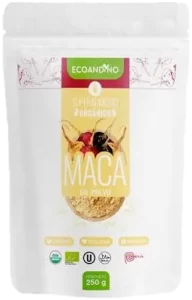
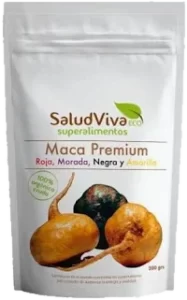
Tricolor maca powder blend combines yellow, red and black maca, the three natural color variants of Lepidium meyenii, in a single gelatinized powder. Instead of choosing between the mildness of yellow, the sweetness of red and the intensity of black, you get all three. According to the producer, the root is sun-dried in the central Peruvian Andes before gelatinizing.
What is tricolor maca?
Maca grows in three broad color types that appear together in the same field: yellow (about 60% of a harvest), red (about 25%) and black (15% or less). After harvest they’re separated by hand. A tricolor blend puts them back together deliberately.
The logic is straightforward. Each color tastes a little different: yellow is the mildest, red the sweetest, and black the strongest and most roasted. A blend gives you all three in one product rather than three jars in the cupboard.
What makes this maca different
Sun-dried, then gelatinized
According to the producer, the root is dried in the open air before it’s gelatinized. Sun-drying on the high plateau, through bright days and freezing nights, is the traditional Andean method and is credited with developing maca’s caramel notes. Gelatinizing afterwards is a cooking step that partly breaks down the starch, so the powder mixes more smoothly.
The full color range
Most maca on the market is single-color or unspecified. This one names all three.
Grown without pesticides
Grown without pesticides in the central Andes, as stated by the producer.
Taste profile
The most complex of the maca powders: yellow’s malt, red’s sweetness and black’s roasted, almost cocoa-like depth in one spoon. Fuller and slightly darker in flavor than yellow maca alone.
How to use it
Daily serving
Adults: 1 tablespoon (about 5 g), once or twice a day, dissolved in a liquid of your choice. Children: 1 teaspoon, once or twice a day. Dissolve in milk, juice, water or a smoothie.
Ways to use it
| Use | How |
|---|---|
| Milk or plant milk | 1 tbsp stirred into a glass |
| Juice | Shake into orange or apple juice |
| Smoothies | With banana and cacao |
| Porridge | Stir in off the heat |
| Hot chocolate | 1 tbsp with cacao powder |
| Baking | Cookies and snack bars |
Where it comes from
Central Peruvian Andes, as declared by the producer. The root is harvested and dried in the open air, the traditional Andean post-harvest method, then gelatinized so the powder mixes easily into liquids.
Who it’s for
A good fit if you can’t decide between the colors, want to try all three in one product, or are buying for a household with different tastes.
Look elsewhere if you want the distinct taste of one color: a blend evens them out. Note also that this is a premium-priced product for its size. If you’re pregnant, breastfeeding or have a thyroid condition, talk to your doctor before taking maca.
Nutrition
Reference values for gelatinized maca powder, per 100 g. The label on the pack may differ slightly.
| Energy | About 330 kcal |
|---|---|
| Protein | 15 g |
| Carbohydrate | 68 g |
| of which fiber | 8 g |
| Fat | 1.2 g |
| Calcium | 250 mg |
| Iron | 15 mg |
| Potassium | 2,000 mg |
Specifications
| Botanical name | Lepidium meyenii |
|---|---|
| Composition | Yellow + red + black maca |
| Processing | Sun-dried, gelatinized, milled |
| Cultivation | Grown without pesticides (as stated by the producer) |
| Net weight | 200 g / 7 oz |
| Adult serving | 1 tbsp, 1–2× a day |
| Child serving | 1 tsp, 1–2× a day |
| Origin | Central Peruvian Andes |
Tricolor maca blend compared with single-color maca
| Tricolor blend | Yellow only | Black only | Red only | |
|---|---|---|---|---|
| Colors | All three | One | One | One |
| Flavor | Fullest | Mildest | Strongest | Sweetest |
| Best for | Not sure which to pick | Beginners, everyday use | Coffee, cacao drinks | Smoothies, yogurt |
Storage
Keep it cool, dry and sealed, out of sunlight. Close the container between uses.
Questions
Is tricolor maca better than single-color maca?
Neither is better; they answer different questions. A blend gives you all three maca colors in one product. A single color lets you pick the taste you prefer. If you know what you’re after, buy single; if you don’t, buy the blend.
What proportions of each color are in a tricolor blend?
Exact ratios are rarely published. The natural harvest ratio is roughly 60% yellow, 25% red and 15% black; check the pack for what this producer uses.
Can children take maca?
In Peru maca is a traditional family food and children are often given a teaspoon rather than a tablespoon, which matches this pack’s instructions. Talk to your pediatrician before adding it to a child’s diet.
What does sun-drying do to maca?
Drying the root in the open air, through high-altitude sun and freezing nights, is the traditional Andean method. It’s credited with developing maca’s caramel and malt notes.
Does gelatinizing make maca stronger?
Not really. Gelatinizing is a cooking step that partly breaks down the starch so the powder mixes more smoothly. It softens the flavor a little rather than making it stronger, and nutrition values per 100 g stay close to those of raw maca.
Can I take maca twice a day?
Yes. One tablespoon once or twice a day is the producer’s range for adults. Splitting it between morning and midday is common.
How many servings are in a 200 g pack?
About 40 adult servings of 5 g, or about 20 days at two tablespoons a day.