
In short
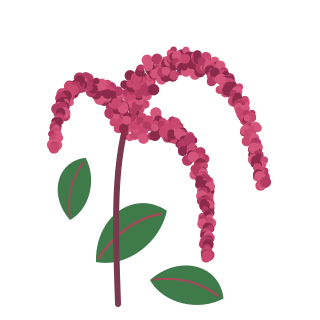
Kiwicha flour 200g is milled Peruvian amaranth (Amaranthus caudatus): “kiwicha” is simply the Quechua name for the grain English speakers call amaranth. It’s naturally gluten free, has 12.9 g of protein per 100 g as declared on the pack, and is used across Peru for cakes, breads and porridge.
What is kiwicha?
Kiwicha is the Quechua name for amaranth (Amaranthus caudatus), a grain-like seed cultivated in the Andes for at least 4,000 years. It isn’t a true cereal. It’s a pseudocereal, like quinoa and buckwheat, meaning it’s used as a grain but comes from a broadleaf plant rather than a grass. That’s why it contains no gluten.
Amaranth was a staple of Andean and Mesoamerican civilizations, and its cultivation was discouraged under Spanish colonial rule because of its ceremonial role. It survived in remote Andean valleys and drew renewed interest in the 20th century for its protein: amaranth protein contains more lysine, an essential amino acid, than the protein of wheat, maize or rice.
What makes this kiwicha flour different
The everyday format
Sold as a kitchen flour rather than a health-food supplement, in the plain bag Peruvian households buy. It’s the least expensive way into the grain.
A published nutrition panel
358 kcal, 73.4 g carbohydrate, 12.9 g protein and 6 g fat per 100 g: real numbers from the pack, which is unusual in this category.
Milled for baking
Positioned for cakes and queques, which means a fine grind that folds into batter cleanly.
Taste profile
Mild, nutty and faintly malty, with a slight earthiness. Softer than buckwheat, more characterful than rice flour. In a cake it reads as a warm, nutty background rather than as a distinct ingredient.
How to use kiwicha flour
Daily serving
1 tablespoon (about 10 g) stirred into oatmeal or a smoothie, or by recipe weight in baking.
Ways to use it
| Use | How |
|---|---|
| Cakes and muffins | Replace 20–30% of the wheat flour |
| Gluten-free baking | Up to 25% of a gluten-free flour blend |
| Porridge | 30 g cooked in 200 ml milk or water |
| Smoothies | 10 g for a nutty note |
| Pancakes | 25% of the flour weight |
| Thickening | 1 tbsp into soups and sauces |
| Baby porridge | A traditional Andean first food, always cooked; ask your pediatrician first |
Baking note: amaranth has no gluten, so keep substitutions at 20–30% in a wheat recipe. Beyond that the crumb becomes dense.
Where it comes from
Peru. Kiwicha is grown across the Andean valleys, mainly in Cusco, Ancash, Ayacucho, Arequipa and Cajamarca, typically between 1,500 and 3,500 meters.
Who it’s for
A good fit if you bake gluten-free, want to add protein and a nutty flavor to baked goods, or are exploring Andean grains for the first time.
Look elsewhere if you need certified organic or certified gluten-free: this is a standard commercial flour. If you have celiac disease, choose a product with a certified gluten-free mark, which also covers cross-contamination.
Nutrition
Values per 100 g as declared on the pack.
| Energy | 358 kcal |
|---|---|
| Carbohydrate | 73.4 g |
| Protein | 12.9 g |
| Fat | 6 g |
Specifications
| Botanical name | Amaranthus caudatus |
|---|---|
| Common names | Kiwicha (Quechua), amaranth (English) |
| Type | Pseudocereal |
| Gluten | None in the grain; not certified gluten free |
| Ingredients | Kiwicha grains |
| Net weight | 200 g / 7 oz |
| Best use | Baking, porridge |
| Origin | Peru |
Kiwicha, quinoa and wheat compared
| Kiwicha (amaranth) | Quinoa | Wheat | |
|---|---|---|---|
| Protein per 100 g | About 13–15 g | About 13 g | About 10 g |
| Gluten | None | None | Yes |
| Flavor | Nutty, mild | Slightly bitter | Neutral |
| Max substitution in bread | 20–30% | 20–30% | 100% |
Storage
Keep it airtight, cool and dry, away from sunlight. Amaranth flour contains about 6% fat, more than most flours, and that fat can go rancid, so use it within six months and keep it sealed.
Questions
What is kiwicha in English?
Amaranth. “Kiwicha” is the Quechua name for Amaranthus caudatus, the Andean species; English-language markets sell it as amaranth. The grain, the flour and the puffed version all come from the same plant.
Is kiwicha gluten-free?
Yes. Amaranth is a pseudocereal from a broadleaf plant rather than a grass, so it contains no gluten. This flour isn’t certified gluten free, though: if you have celiac disease, look for a certified gluten-free mark, which also covers cross-contamination in processing.
Is kiwicha the same as quinoa?
No, though they’re used in similar ways. Both are Andean pseudocereals and naturally gluten free. Kiwicha has smaller seeds and a milder, nuttier taste; quinoa has larger seeds and a slightly bitter note from its saponin coating.
How much protein is in kiwicha flour?
12.9 g per 100 g as declared on this pack, and about 13–16 g across amaranth flours generally, compared with about 10 g in white wheat flour.
Can I substitute kiwicha flour for wheat flour?
Partially. Replace 20–30% of the wheat flour in a recipe. Because it has no gluten, a full substitution gives a dense, crumbly result unless the recipe was designed for it.
What does kiwicha flour taste like?
Mild and nutty with a faint earthy, malty note. It’s one of the more approachable gluten-free flours, much softer in flavor than buckwheat or chickpea flour.
Why was amaranth suppressed historically?
It had a ceremonial role in Andean and Mesoamerican societies, and Spanish colonial authorities discouraged its cultivation. It survived in remote highland areas and was reintroduced to wider agriculture in the 20th century.