

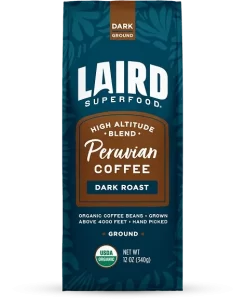
In short
Peruvian dark roast coffee, ground for espresso, is 100% arabica from Chanchamayo, roasted dark and milled fine for espresso machines and moka pots. The dark roast gives it a full body and low acidity, and it holds up under milk, which is what an espresso base has to do.
What is espresso-ground coffee?
Grind size determines how fast water passes through coffee. Espresso needs a fine grind, because the water is forced through under nine bars of pressure in 25–30 seconds. Filter needs a medium grind, French press a coarse one.
A bag ground for espresso isn’t a different coffee. It’s the same beans milled finer. Using it in a filter machine will over-extract and taste bitter; using filter grind in an espresso machine will under-extract and taste sour and thin.
What makes this coffee different
Dark roast, and that’s a deliberate choice
Peru’s specialty coffee is usually roasted light to medium to show off its acidity. Dark roasting trades that brightness for body, sweetness and chocolate depth, the profile that works in espresso and, above all, under milk.
100% arabica, declared
No robusta in the blend. Robusta is often added to espresso for crema and caffeine; this is straight arabica.
Chanchamayo origin at espresso grind
An origin-specific espresso rather than an anonymous blend.
Taste profile
Full-bodied and low in acidity, with dark chocolate, toasted nut and caramel notes and a lingering finish. In milk it comes through clearly rather than disappearing, the practical test of any espresso roast.
How to brew it
Standard serving
18 g for a double espresso, yielding about 36 ml in 25–30 seconds. 7–9 g for a single.
Brewing methods
| Method | Dose | Notes |
|---|---|---|
| Espresso machine | 18 g double | 25–30 s, about 36 ml out |
| Moka pot | Fill basket level | Never tamp; low heat |
| AeroPress | 17 g | Fine grind works well |
| Latte / cappuccino | 18 g double | Holds up under milk |
| Filter | Not recommended | Grind too fine, over-extracts |
Where it comes from
Chanchamayo, Junín, Peru, 1,200–1,800 m on the eastern Andean slope. Peru’s coffee is overwhelmingly smallholder-grown arabica, and Chanchamayo is one of the valleys where the industry began.
Who it’s for
A good fit if you own an espresso machine or a moka pot, drink flat whites and lattes, or prefer a low-acid, full-bodied cup.
Look elsewhere if you brew with a filter machine or a French press: the grind is wrong and it will taste bitter. It’s also not the choice if you want a bright, acidic, fruit-forward coffee.
Nutrition
Reference values for ground coffee, per 10 g serving of dry coffee. The label on the pack may differ slightly. Brewed espresso extracts only a fraction of this, so a black double espresso is essentially calorie-free.
| Energy | About 43 kcal |
|---|---|
| Carbohydrate | About 7 g |
| of which sugars | Less than 0.1 g |
| Protein | About 1.5 g |
| Fat | About 1 g |
Specifications
| Species | Coffea arabica, 100% |
|---|---|
| Origin | Chanchamayo, Junín, Peru |
| Roast | Dark |
| Grind | Espresso (fine) |
| Net weight | 200 g / 7 oz |
| Servings | About 11 double espressos |
| Decaffeinated | No |
Coffee grind sizes compared
| Texture | Method | Contact time | |
|---|---|---|---|
| Extra fine | Powder | Turkish | 2–3 min |
| Fine (this bag) | Table salt | Espresso, moka | 25–30 s |
| Medium | Sand | Filter, drip | 3–4 min |
| Coarse | Sea salt | French press | 4 min |
| Extra coarse | Breadcrumbs | Cold brew | 12–16 h |
Storage
Keep it airtight, cool, dry and away from light. Fine grinds go stale faster than coarse ones because of their larger surface area, so use it within three weeks of opening.
Questions
Can I use espresso-ground coffee in a filter machine?
You can, but it will taste bitter and over-extracted because the water passes through too slowly. Match the grind to the method.
What’s the difference between espresso roast and espresso grind?
Roast is how dark the beans were roasted; grind is how finely they were milled. “Espresso coffee” usually means both, a darker roast and a fine grind, but they’re separate variables.
Is dark roast coffee stronger?
In flavor, yes: more body, more bitterness, more chocolate depth. In caffeine, no: dark roasting slightly reduces caffeine by weight. “Strong” in flavor and “strong” in caffeine are different things.
How much coffee for a double espresso?
18 g in, about 36 ml out, in 25–30 seconds. That’s the standard modern recipe and a reasonable starting point on any machine.
Can I use this in a moka pot?
Yes. Moka pots want a fine-to-medium grind and a dark roast. Fill the basket level and never tamp; tamping blocks the flow and can raise the pressure dangerously.
Does Peruvian coffee work as espresso?
Yes, particularly darker-roasted lots from Chanchamayo and Villa Rica, which have the body and sweetness espresso needs. Very bright northern Peruvian coffees are better as filter.
Why does my espresso taste sour?
Usually under-extraction: grind too coarse, dose too low, or water passing through too fast. Grind finer or increase the dose.