

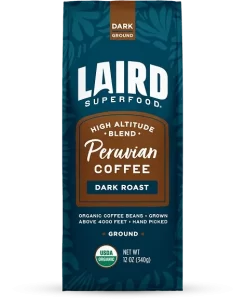
In short
Peruvian ground coffee in the classic roast is the everyday tier: the same format as the gourmet line at a lower price, with 45 cups per bag. It’s pure coffee with no fillers, roasted to a standard profile that works in any drip machine, and it’s the best cost per cup in the range.
What is classic-roast ground coffee?
It’s the standard tier of a coffee range: a straightforward roast profile designed to taste the same every time, brew well in an ordinary drip machine, and cost less than the selected line above it.
It isn’t a lesser coffee so much as a different job. A single-origin lot is bought to taste of somewhere. A classic house roast is bought to be reliable at eight in the morning.
What makes this coffee different
The economics
At 45 cups per bag and the lowest price per gram in the ground range, this is the cost-per-cup winner. If coffee is a daily habit rather than a hobby, that adds up quickly.
Pure coffee
No chicory, no barley, no extenders, which is worth checking on any budget-tier ground coffee.
Consistency over character
Blended and roasted to taste the same bag after bag. That’s the point of a classic line.
Taste profile
Straightforward and balanced: medium body, mild acidity, with nutty and lightly toasted notes. It takes milk and sugar well and doesn’t fight you at breakfast.
How to brew it
Standard serving
10 g per 240 ml cup. 450 g gives 45 cups.
Brewing methods
| Method | Dose | Notes |
|---|---|---|
| Drip machine | 10 g per cup | The intended use |
| Batch brew | 60 g per liter | For a full pot |
| French press | 15 g per 250 ml | 4 minutes |
| Moka pot | Basket level | Don’t tamp |
| Cold brew | 60 g per liter | 12–16 h |
| With milk | 12 g per cup | Increase the dose slightly |
Where it comes from
Peruvian coffee, grown on the eastern Andean slope. Peru is one of the world’s leading producers of organic and fair-trade certified coffee, with production dominated by smallholders working a few hectares each.
Who it’s for
A good fit if you drink several cups a day, run an office or shared kitchen, or want the lowest cost per cup without extended or adulterated coffee.
Look elsewhere if you want origin character or a distinctive cup: a single origin from Cajamarca or Villa Rica is a different purchase.
Nutrition
Reference values for ground coffee, per 100 g. The label on the pack may differ slightly. A 10 g serving of dry coffee is roughly 43 kcal, and a brewed black cup extracts almost none of it.
| Energy | 428.49 kcal |
|---|---|
| Protein | 15.16 g |
| Carbohydrate | 65.66 g |
| of which sugars | Less than 0.2 g |
| Fat | 11.69 g |
| of which saturated fat | 5.71 g |
| Sodium | 22.7 mg |
Specifications
| Format | Roasted and ground |
|---|---|
| Line | Classic, everyday |
| Pure coffee | Yes |
| Decaffeinated | No |
| Net weight | 450 g / 15.9 oz |
| Servings | 45 × 10 g |
| Origin | Peru |
Classic and gourmet lines compared
| Classic | Gourmet | |
|---|---|---|
| Bean selection | Standard | Selected |
| Roast | House profile | More controlled |
| Consistency | Very high | High |
| Character | Neutral | More distinct |
| Price per cup | Lowest | Higher |
| Best for | Daily habit | Weekend cup |
Storage
Keep it airtight, cool, dry and dark. Decant a week at a time from a 450 g bag and keep the rest sealed. Never refrigerate.
Questions
Is classic-roast coffee lower quality than gourmet?
It’s a different tier: standard bean selection and a house roast profile built for consistency rather than character. For everyday drinking with milk, most people can’t tell the difference.
What are coffee “fillers”?
Chicory, barley, corn and other roasted plant material added to bulk out ground coffee. They’re legal when declared but change the taste substantially. A “pure coffee” declaration confirms there are none.
How many cups will 450 g give me?
45 at the standard 10 g per cup. For a household drinking three cups a day, that’s about two weeks.
Does cheaper coffee have more caffeine?
No. Caffeine depends on the species (robusta has roughly double the caffeine of arabica), the dose and the brew method, not on price.
Can I use ground coffee for cold brew?
Yes. Use 60 g per liter of cold water, steep 12–16 hours in the fridge, then strain. A coarser grind is better, but a standard grind works if you filter carefully.
Why does my drip coffee taste weak?
Usually it’s the dose, not the coffee. Most people under-dose. Try 12–15 g per 240 ml and check that your machine actually reaches 90–96 °C (194–205 °F).
How long after roasting is coffee at its best?
Whole beans peak roughly 5–14 days after roasting. Ground coffee in a sealed retail bag is stable until opened, then best within three to four weeks.