

In short
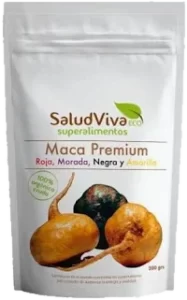
Red maca powder with macamides is gelatinized red maca from the Peruvian altiplano, grown at 4,000–4,500 meters according to the producer. Macamides are a family of fatty acid amides that, as far as published research shows, occur only in maca, which makes them the clearest chemical marker of the root. This 200 g doypack holds about 66 servings at the recommended 3 g serving.
What are macamides?
Macamides are a class of fatty acid amides found in maca and, as far as published research records, nowhere else in the plant kingdom. They’re the compound family chemists use to tell maca apart from other root vegetables, and their concentration varies with color type, altitude and how the root was dried.
Along with glucosinolates and macaenes, they form the group of compounds that give maca its identity. This is one of the few maca products that names them on the label.
What makes this red maca different
The signature compound family is named
Most maca packaging talks about “nutrients”. Naming macamides specifically is more useful: it’s the marker that separates maca from any other Andean root powder.
Precise altitude, precise serving
4,000–4,500 meters, and one teaspoon (3 g) in water or juice. Both figures are stated rather than implied.
The sweetest of the three colors
Red maca is sweeter than yellow and far less roasted than black, which is why a 3 g teaspoon works stirred into plain water or juice.
Taste profile
Sweet, malty and caramel-forward, the most drinkable of the three maca colors. Gelatinization softens any bitterness, so a teaspoon in water is genuinely pleasant.
How to use it
Daily serving
One teaspoon (3 g) stirred into a glass of water or juice. 200 g gives about 66 servings, a little over two months.
Ways to use it
| Use | How |
|---|---|
| Water | 3 g stirred into a glass |
| Juice | Orange, apple or passion fruit (maracuyá) |
| Smoothies | With banana or berries |
| Porridge | Off the heat |
| Yogurt | Folded in with honey |
| Warm milk | Whisked in, morning or evening |
Where it comes from
Peruvian Andes, 4,000–4,500 m, as stated by the producer. Red maca is a minority color type in every harvest, around a quarter of the roots, separated by hand after lifting and processed apart from yellow and black.
Who it’s for
A good fit if you want to know what’s actually in the powder, prefer a 3 g daily teaspoon, or want a two-month supply in one resealable pack.
Look elsewhere if you want a stated macamide amount: the pack names macamides but doesn’t give a figure. If you’re pregnant, breastfeeding or have a thyroid condition, talk to your doctor before taking maca.
Nutrition
Reference values for gelatinized red maca powder, per 100 g. The label on the pack may differ slightly.
| Energy | About 330 kcal |
|---|---|
| Protein | 15 g |
| Carbohydrate | 68 g |
| of which fiber | 8 g |
| Fat | 1.2 g |
| Calcium | 250 mg |
| Iron | 15 mg |
| Potassium | 2,000 mg |
Specifications
| Botanical name | Lepidium meyenii Walp. |
|---|---|
| Variety | Red maca |
| Key compounds | Macamides |
| Altitude | 4,000–4,500 m |
| Processing | Gelatinized |
| Net weight | 200 g / 7 oz |
| Serving | 1 tsp (3 g) |
| Servings | About 66 |
| Storage | 18–25 °C (64–77 °F), 50–65% humidity |
Maca’s main compound families
| Found in | Notes | |
|---|---|---|
| Macamides | Maca only | The signature compounds of the species |
| Glucosinolates | Maca and other brassicas | Shared with broccoli, radish, mustard |
| Phytosterols | Many plants | Common across seeds, nuts, roots |
| Macaenes | Maca only | Related to macamides |
Storage
Store at 18–25 °C (64–77 °F) and 50–65% humidity, away from direct sunlight. Reseal the doypack fully after each use.
Questions
What are macamides?
Fatty acid amides found, as far as published research shows, only in maca. They’re the most studied compound family in maca and the one that sets it apart chemically from other roots, which makes them a useful marker that you’re getting real maca.
Do all macas contain macamides?
Yes, in varying amounts. Concentration depends on color type, growing altitude and how the root was dried; high heat reduces them.
Does it dissolve in cold water?
Yes. It’s gelatinized, so a 3 g teaspoon stirs into a glass of cold water or juice. Stir again if it sits for a while.
How is red maca different from yellow and black?
They’re color variants of the same root. Red makes up about a quarter of a harvest and is the sweetest of the three; yellow is the most common and the mildest, and black is the scarcest, with the strongest taste.
How long does 200 g last?
About 66 days at a 3 g teaspoon, or 40 days at a 5 g tablespoon.
Why is the serving 3 g here and 5 g elsewhere?
Producers state different servings within a normal range. Anywhere between 3 and 10 g a day is common. Start at the lower end and adjust to taste.
Does gelatinizing reduce macamide content?
Gelatinization is a brief, low-pressure cooking step, and its effect on macamides is small compared with high-temperature drying. The drying method matters far more.