The short answer
Bulgur wheat vs quinoa comes down to gluten and protein. Bulgur is cracked, partly cooked wheat, so it contains gluten, and per cooked cup it has fewer calories and more fiber. Quinoa is a gluten-free seed with more protein, magnesium and iron. Both cook in about 12 minutes in twice their volume of water.
Bulgur wheat vs quinoa at a glance
| Bulgur wheat | Quinoa | |
|---|---|---|
| What it is | Cracked wheat, partly cooked | A seed eaten as a whole grain |
| Gluten | Yes (it’s wheat) | No, naturally gluten-free |
| Calories per cooked cup | 151 | 222 |
| Protein per cooked cup | 5.6 g | 8.1 g |
| Fiber per cooked cup | 8.2 g | 5.2 g |
| Water per 1 cup dry | 2 cups | 2 cups |
| Cook time | About 12 min | About 12 min, plus 5–10 min resting |
| Yield from 1 cup dry | About 3 cups | About 3 cups |
| Classic uses | Tabbouleh, pilaf | Salads, bowls, gluten-free sides |
Sources: USDA FoodData Central (bulgur 170287, quinoa 168917; cup values calculated from USDA’s cup weights); Oregon State University Extension (cooking); University of Arizona and Harvard (gluten). Full links below.
What bulgur and quinoa are
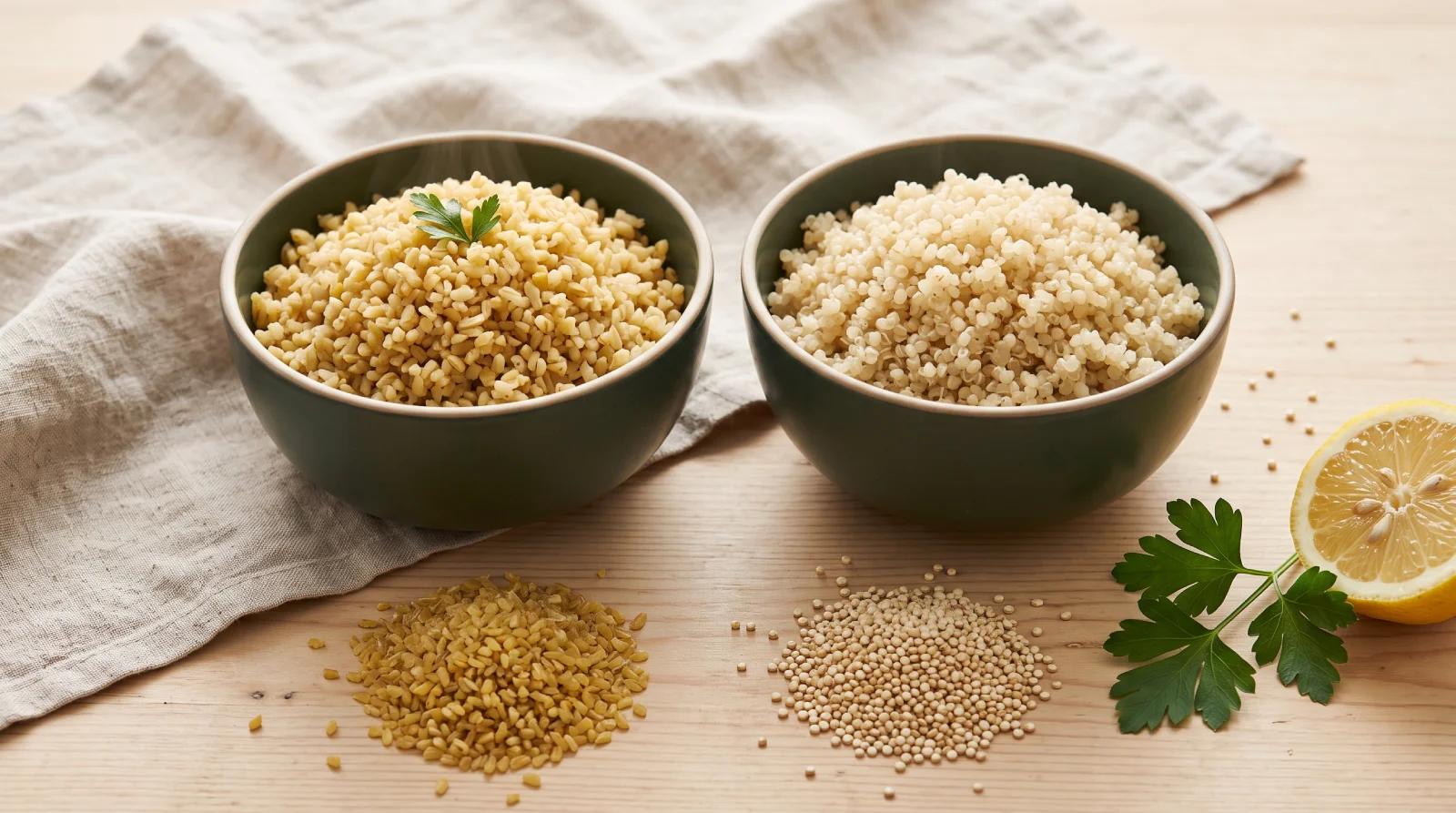
Bulgur (sometimes spelled bulgar) is wheat that has been cracked and partly cooked, so it needs only a short simmer, as South Dakota State University Extension describes it. It’s the grain in tabbouleh and in many pilafs.
Quinoa isn’t a cereal at all. It’s the seed of an Andean plant, classified as a whole grain, and it has been cultivated for about 5,000 years, according to Harvard’s Nutrition Source.
Bulgur vs quinoa nutrition per cooked cup
For quinoa vs bulgur on nutrition, compare them cooked, since that’s how you eat them. Quinoa is higher in calories, protein, fat and most minerals. Bulgur is higher in fiber and niacin.
| Nutrient | Bulgur, 100 g | Bulgur, 1 cup (182 g) | Quinoa, 100 g | Quinoa, 1 cup (185 g) |
|---|---|---|---|---|
| Calories | 83 | 151 | 120 | 222 |
| Protein | 3.1 g | 5.6 g | 4.4 g | 8.1 g |
| Carbohydrates | 18.6 g | 33.9 g | 21.3 g | 39.4 g |
| Fiber | 4.5 g | 8.2 g | 2.8 g | 5.2 g |
| Fat | 0.2 g | 0.4 g | 1.9 g | 3.6 g |
| Iron | 0.96 mg | 1.7 mg | 1.49 mg | 2.8 mg |
| Magnesium | 32 mg | 58 mg | 64 mg | 118 mg |
| Phosphorus | 40 mg | 73 mg | 152 mg | 281 mg |
| Potassium | 68 mg | 124 mg | 172 mg | 318 mg |
| Zinc | 0.57 mg | 1.0 mg | 1.09 mg | 2.0 mg |
| Folate | 18 µg | 33 µg | 42 µg | 78 µg |
| Niacin (B3) | 1.0 mg | 1.8 mg | 0.41 mg | 0.76 mg |
Source: USDA FDC 170287 (bulgur, cooked) and USDA FDC 168917 (quinoa, cooked). Cup values are our math from USDA’s gram weight for 1 cup; a cup you measure at home may weigh a little more or less.
Calories and carbs
Per cooked cup, bulgur has about 151 calories and quinoa about 222. Part of the gap is fat: quinoa carries about 3.6 g per cup, bulgur less than half a gram.
Protein and fiber
Quinoa gives about 8 g of protein per cup against 5.6 g for bulgur. Harvard notes that quinoa is a complete protein, with all nine essential amino acids. Fiber runs the other way: about 8 g per cup of bulgur against 5 g in quinoa.
Minerals and vitamins
Cup for cup, quinoa has roughly two to four times the magnesium, zinc, folate, potassium and phosphorus of bulgur, and about 60% more iron. Bulgur has more niacin. For the uncooked values and every serving size, see full quinoa nutrition facts per 100 g.
Gluten: the difference that decides it
Bulgur is wheat, so it contains gluten. The University of Arizona’s celiac diet guide lists bulgur and tabbouleh among the foods to avoid. Quinoa is naturally gluten-free, and Harvard says it can be eaten safely by people with celiac disease.
The catch is processing. Naturally gluten-free grains can share lines with wheat or sit in bulk bins with shared scoops, so the same Arizona guide advises choosing products made in a gluten-free facility. If gluten is a medical issue for you, read the pack, not just the grain’s name.
How to cook bulgur and quinoa
Bulgur has a reputation as the faster grain, but Oregon State University Extension gives both the same basic method: 1 cup of dry grain, 2 cups of water, about 12 minutes at a simmer and about 3 cups once cooked.
Bulgur
Bring the bulgur and water to a boil, cover, turn the heat down and simmer for about 12 minutes, until tender. Drain off any water that’s left. Bulgur comes in several grinds, and finer ones need less time, so check the pack.
Quinoa
Rinse the quinoa in a fine-mesh strainer unless the pack says it’s pre-rinsed. The seeds carry bitter saponins on the outside, and most packaged quinoa has already been washed, Harvard notes. Boil the water, add the quinoa, cover and simmer for 12 minutes, then let it stand off the heat for 5 to 10 minutes before fluffing.
Cooking bulgur and quinoa together
Because they cook alike, bulgur and quinoa can share a pot. In Loma Linda University’s pilaf, 1 cup of each is toasted in a dry skillet, then simmered with onion, celery and herbs in 4 cups of low-sodium stock for 20 minutes, covered, and rested for 5. It’s still a wheat dish, so it isn’t for a gluten-free table.
Taste and texture
Cooked bulgur tastes mild and wheaty, a little like whole-wheat bread, with a soft chew that soaks up lemon and oil. Quinoa is lighter and slightly nutty, with an earthy note, and each seed keeps a small bite. If quinoa tastes soapy or bitter, it wasn’t rinsed enough. Both work warm or cold.
Bulgur or quinoa: which to choose
Choose quinoa if:
- you or someone at the table avoids gluten
- you want more protein per serving without adding beans or meat
- you’re after more magnesium, iron and folate per cup
Choose bulgur if:
- you want fewer calories and more fiber per cup
- you’re making tabbouleh or a classic pilaf
- gluten isn’t an issue and you like a softer, wheatier grain
If you need another gluten-free grain, see how millet stacks up against quinoa. For a warm breakfast bowl, the more useful comparison is quinoa or oats.
Can you substitute quinoa for bulgur wheat?
Yes, in salads, bowls and pilafs. Swap cooked grain for cooked grain, cup for cup. You can also swap them dry, since both use 2 cups of water per cup and give about 3 cups. The swap only fails in one direction: bulgur can’t replace quinoa on a gluten-free menu. There are other good substitutes for quinoa if bulgur isn’t the right fit.
Frequently asked questions
Does bulgur have more protein than rice?
More than white rice and about the same as brown. Per cooked cup, USDA lists 5.6 g of protein for bulgur, 5.5 g for brown rice and 4.3 g for enriched white rice. The bigger difference is fiber: about 8.2 g in bulgur against 3.2 g in brown rice and 0.6 g in white.
Is bulgur or quinoa better for weight loss?
Neither grain makes you lose weight on its own. Per cooked cup, bulgur has about 70 fewer calories and 3 g more fiber, while quinoa has more protein (USDA). If you’re counting calories, bulgur goes further; if you need gluten-free food, quinoa is the one to use.
Is bulgur or quinoa better for blood sugar?
Per cooked cup, bulgur has about 26 g of carbohydrate once fiber is taken out, against about 34 g for quinoa, based on the USDA figures above. Portion size and the rest of the meal matter as much as the grain. For quinoa’s glycemic load by portion, see our guide to the quinoa glycemic index.
Is bulgur the same as couscous?
No. Bulgur is cracked wheat that has been partly cooked. Couscous is a tiny pasta made from ground wheat, rolled into small balls, according to South Dakota State University Extension. Both contain gluten. Bulgur is chewier and holds its shape in salads, while couscous is softer and cooks in a few minutes off the heat.
Is bulgur a whole grain?
Yes. Harvard’s whole grains guide lists bulgur alongside quinoa, barley, millet and buckwheat. There’s no official ranking of the single healthiest grain. Both bulgur and quinoa count toward your whole grains, and the right one depends on gluten, taste and what else is on your plate.
Shop Peruvian quinoa flour
We sell quinoa ground into Peruvian quinoa flour, not as whole grain: it’s bought in Peru, label checked, and sent from Lima. If you need it gluten-free, check what the pack says.

Sources
- USDA Agricultural Research Service, 2019. Quinoa, cooked (FDC 168917); Bulgur, cooked (170287); Rice, brown, long-grain, cooked (169704); Rice, white, long-grain, enriched, cooked (168878). FoodData Central, SR Legacy.
- Oregon State University Extension Service, Food Hero, 2022. Cook whole grains on the stovetop.
- University of Arizona Campus Health, 2014. Celiac disease and your gluten free diet.
- Harvard T.H. Chan School of Public Health, The Nutrition Source. Quinoa (2017, updated 2024) and Whole grains (updated 2025).
- South Dakota State University Extension, 2022. Consumer decision making skill-a-thon: food and cooking ID definitions.
- Loma Linda University, Living Whole Employee Wellness. Bulgur and quinoa pilaf.