The short answer
Lucuma benefits are mostly about what it replaces: a naturally sweet fruit powder with carotenoids and polyphenols that can stand in for part of the sugar in a recipe. The bigger claims, from steadier blood sugar to skin repair, come from lab and animal studies. No published study in people has tested lucuma’s health effects.
Lucuma benefits at a glance: what each claim rests on
Most lists of lucuma powder benefits mix test-tube results with promises about your body. The table below puts each claim next to the kind of study behind it. When we searched PubMed in October 2026, lucuma appeared in 21 records, and none of them tested a health effect in people. The closest was a taste test of lucuma ice cream.
| Claim | What was tested | Type of study | What it found | What we don’t know |
|---|---|---|---|---|
| Antioxidants | Extracts of pulp and skin | Lab (test tube) | Catechins, quercetin and other polyphenols, plus carotenoids; skin richer than pulp | Whether eating the powder changes anything in your body |
| Blood sugar | Fruit extracts against carb-digesting enzymes | Lab (test tube) | Lucuma and algarrobo water extracts blocked alpha-glucosidase most among the fruits tested | Any effect in people; no published glycemic index |
| Diabetes-related eye damage (one compound) | Eriodictyol, a compound found in lucuma, given on its own | Rats | Less retinal inflammation and less fat oxidation in the blood of diabetic rats | Whether the amount in lucuma does anything |
| Blood pressure | Fruit extracts against ACE, an enzyme that raises blood pressure | Lab (test tube) | Part of the 2009 screen; reviews that repeat the claim give no figures | Everything beyond the test tube |
| Skin and wounds | Oil from the seed, applied to wounds | Cells, zebrafish, mice | Wounds closed faster in mice | Any effect of eating the powder or putting it on skin |
| Cancer | Compounds that lucuma shares with other plants, not lucuma | Cells, mice | Not applicable | No study has used lucuma |
Sources: Pinto et al. 2009; Masullo et al. 2021; Rojo et al. 2010; review by Maza-De la Quintana and Paucar-Menacho 2020.
What lucuma powder is, and why that matters here
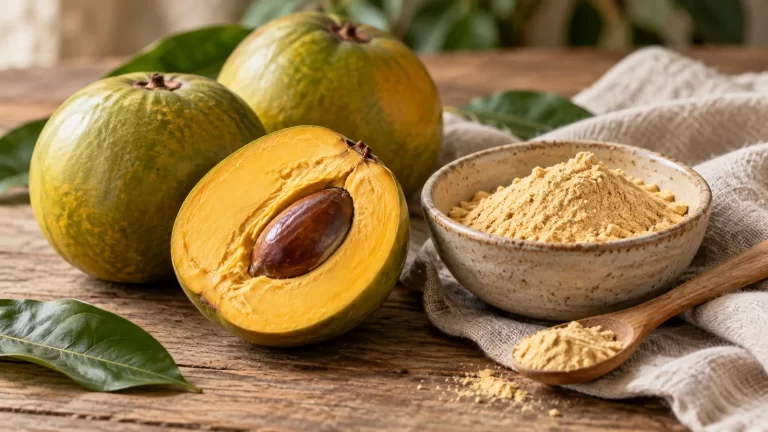
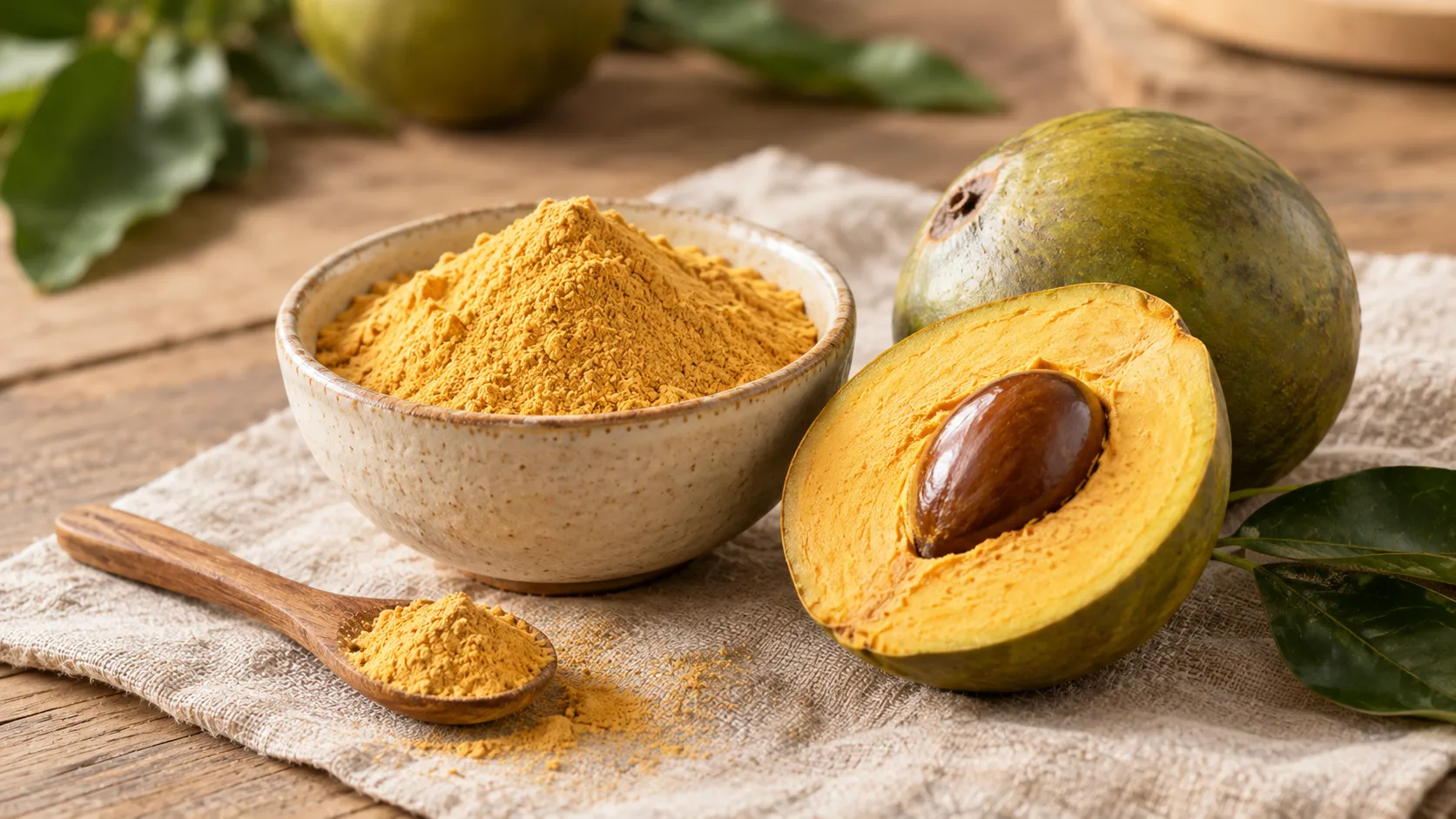
Lucuma powder is the dried, ground flesh of lucuma, an Andean fruit now classed as Lucuma bifera and long known as Pouteria lucuma. Our guide to where lucuma grows and how it’s eaten in Peru covers the fruit itself. For the health claims, two points matter.
First, most studies didn’t use the powder you buy. They used water or alcohol extracts of the pulp or skin, or oil pressed from the seed. Second, lucuma isn’t one fixed thing. In a 2016 analysis of three lucuma types, sugars ranged from about 12% to 34% of the pulp’s dry weight, and phenolic compounds varied even more, depending on the type and on how ripe the fruit was.
Antioxidants: polyphenols and carotenoids, measured in the lab
Lucuma does contain compounds that act as antioxidants in a test tube. A 2021 chemical analysis isolated 20 compounds from the pulp, including catechin, epicatechin, gallocatechin, quercetin and taxifolin. Most had never been reported in lucuma pulp before. Skin extracts had about six times the phenolic content of pulp extracts and scored higher in both antioxidant tests. The 2016 study also measured carotenoids, the yellow-orange pigments, and some vitamin C in the pulp.
The results don’t all line up. A 2009 lab screen of Peruvian fruits found lucuma fruit had the highest total phenolic content of the group, about 11.4 mg per gram of dry weight. Yet the method the authors used to identify single compounds didn’t detect any phenolic compound in lucuma fruit or powder. Antioxidant activity in a test tube also doesn’t tell you what happens after you eat something, and no one has measured it in people eating lucuma.
Blood sugar: enzyme tests, not trials
This is the claim you’ll see most often. It comes from the same 2009 study, which tested fruit extracts against alpha-glucosidase, a gut enzyme that breaks starches and sugars down into glucose. Water extracts of lucuma and of algarrobo, a Peruvian pod, blocked the enzyme more than the other fruits tested. The 2016 study reported a similar effect on alpha-amylase, another starch-digesting enzyme. Both were test-tube experiments, and the 2009 authors wrote that studies in animals and in people were still needed.
The only animal work linked to lucuma and diabetes used eriodictyol, one compound found in the fruit, given on its own to diabetic rats, according to a 2020 review. It doesn’t show that the amount in a spoonful of powder does anything.
Does lucuma spike blood sugar?
No published study has measured it. The 2020 review cites a 2016 Peruvian university thesis that rated lucuma’s glycemic index as medium, not low, without giving a figure, and we couldn’t read the thesis itself. So lucuma’s glycemic index isn’t established, and “low glycemic” on a label isn’t backed by a published test. Lucuma powder is mostly carbohydrate, including natural sugars, so treat it like any other sweet ingredient. If you manage diabetes, count it in your carbs and ask your doctor or dietitian how it fits.
Heart health and blood pressure: no direct evidence
Some articles say lucuma lowers blood pressure because it may block ACE, an enzyme that helps raise it. The 2009 screen tested this enzyme too, but again only with extracts in a test tube, and the 2020 review that repeats the claim reports no figures for it. We found no study of lucuma and heart health in animals or in people.
Lucuma powder skin benefits: the study used seed oil
Searches for lucuma powder skin benefits lead back to one study, and it wasn’t about the powder. In a 2010 study, researchers extracted oil from the lucuma seed, often called the nut, and tested it on human skin cells in a dish, on zebrafish larvae and on mice. In mice with a small skin wound, the best dose of oil, applied daily for 10 days, shrank the wound to half its size in about 5.9 days, against about 7.6 days for wounds treated with the base formula alone. There were five mice per group, and the work was funded by a company, Phytomedics Chile, and by a US National Institutes of Health research center.
So the evidence covers seed oil on wounds in animals. It says nothing about eating lucuma powder or putting it on your face. No study has tested lucuma on human skin.
Lucuma and cancer: what has actually been studied
Nothing, with lucuma itself. The 2020 review that discusses lucuma and cancer cites studies of beta-sitosterol and gallic acid, two compounds lucuma shares with many other plants, tested on cancer cells and in mice. None of those studies used lucuma, and none were in people. There’s no evidence that eating lucuma helps prevent or treat cancer.
Lucuma nutrition in brief
Apart from water, fresh lucuma pulp is mostly carbohydrate, with little protein or fat, according to the three food composition tables compiled in the 2020 review. Some articles say lucuma’s fiber helps digestion. Two of those tables give about 1 g of fiber per 100 g of fresh pulp and the third about 10 g, and we found no study of lucuma and digestion.
There’s no USDA reference entry for lucuma powder, so the per-spoon numbers online come from brand labels and don’t match from site to site. Check the panel on the pack you buy, or see our full lucuma powder nutrition facts.
How to use lucuma powder as a sweetener
In Peru, lucuma goes mainly into ice cream and desserts, and also into yogurt, baked goods and sweets, according to the 2020 review. At home, stir it into smoothies, oatmeal or yogurt, or bake with it for its caramel and maple notes.
Don’t expect it to replace sugar one for one. Sugars make up only part of the dried pulp (see above), so gram for gram it carries far less sugar than table sugar does. Swap it in for part of the sugar, taste, and adjust. Packs of Peruvian lucuma powder vary, so start with a little and build up.
Side effects and who should be careful
No side effects have been reported. That’s because lucuma hasn’t been studied in people, not because it’s been shown to be safe in large amounts. As a food, it’s eaten widely in Peru, mostly in desserts. Lucuma powder still adds sugar and calories, so count it like any other sweet ingredient.
If you’re pregnant or breastfeeding, take medicine for diabetes, or have a long-term health condition, there’s no safety data on lucuma beyond ordinary food use, so talk to your doctor before using it in larger amounts. We cover whether lucuma powder is safe and lucuma during pregnancy in more detail.
Frequently asked questions
Is lucuma a superfood?
“Superfood” is a marketing word, not a scientific category. Lucuma is a nutritious fruit with polyphenols and carotenoids, and its caramel-like sweetness can stand in for part of the sugar in a recipe. That part is real. What’s missing is evidence that it protects your health in any specific way.
Are organic lucuma powder benefits any different?
Organic describes how the fruit was grown and certified, not what’s in it. No study has compared organic and conventional lucuma, so there’s no evidence that organic lucuma powder does more for your health. If organic matters to you for other reasons, look for a certification seal printed on the pack rather than the word alone.
Is lucuma good for you?
As a food, yes: it’s a fruit eaten widely in Peru, mostly carbohydrate, including natural sugars. What it’s good for in the kitchen is flavor, a caramel-like sweetness in ice cream, smoothies, oatmeal and baking that lets you cut some sugar. Count it like any other sweet ingredient, and use it because you like the taste, not for a health promise.
What is the most healing fruit in the world?
There isn’t one. No fruit, lucuma included, has been shown in studies to heal disease on its own, and lists that crown a single “healing fruit” are marketing rather than science. If a product promises to heal, that’s a reason to read the evidence more carefully, starting with what kind of study it comes from.
What country is lucuma from?
Lucuma comes from the Andes of South America, and Peru is its best-known home. It grows in Andean valleys up to about 3,000 m and in coastal valleys too. In Peru it’s used mostly in ice cream and desserts, and it’s sold abroad as frozen pulp and as the dried powder.
Shop Peruvian lucuma powder
We buy lucuma powder in Peru, read the label, and ship it to you.
- Best seller
Sources
- Maza-De la Quintana R, Paucar-Menacho LM, 2020. Lucuma (Pouteria lucuma): composition, bioactive components, antioxidant activity, uses and beneficial properties for health. Scientia Agropecuaria 11(1):135–142.
- Pinto MDS, Ranilla LG, Apostolidis E, et al., 2009. Evaluation of antihyperglycemia and antihypertension potential of native Peruvian fruits using in vitro models. Journal of Medicinal Food 12(2):278–291.
- Fuentealba C, Gálvez L, Cobos A, et al., 2016. Characterization of main primary and secondary metabolites and in vitro antioxidant and antihyperglycemic properties in the mesocarp of three biotypes of Pouteria lucuma. Food Chemistry 190:403–411.
- Masullo M, Cerulli A, Pizza C, Piacente S, 2021. Pouteria lucuma pulp and skin: in depth chemical profile and evaluation of antioxidant activity. Molecules 26(17):5236.
- Rojo LE, Villano CM, Joseph G, et al., 2010. Wound-healing properties of nut oil from Pouteria lucuma. Journal of Cosmetic Dermatology 9(3):185–195.