The short answer
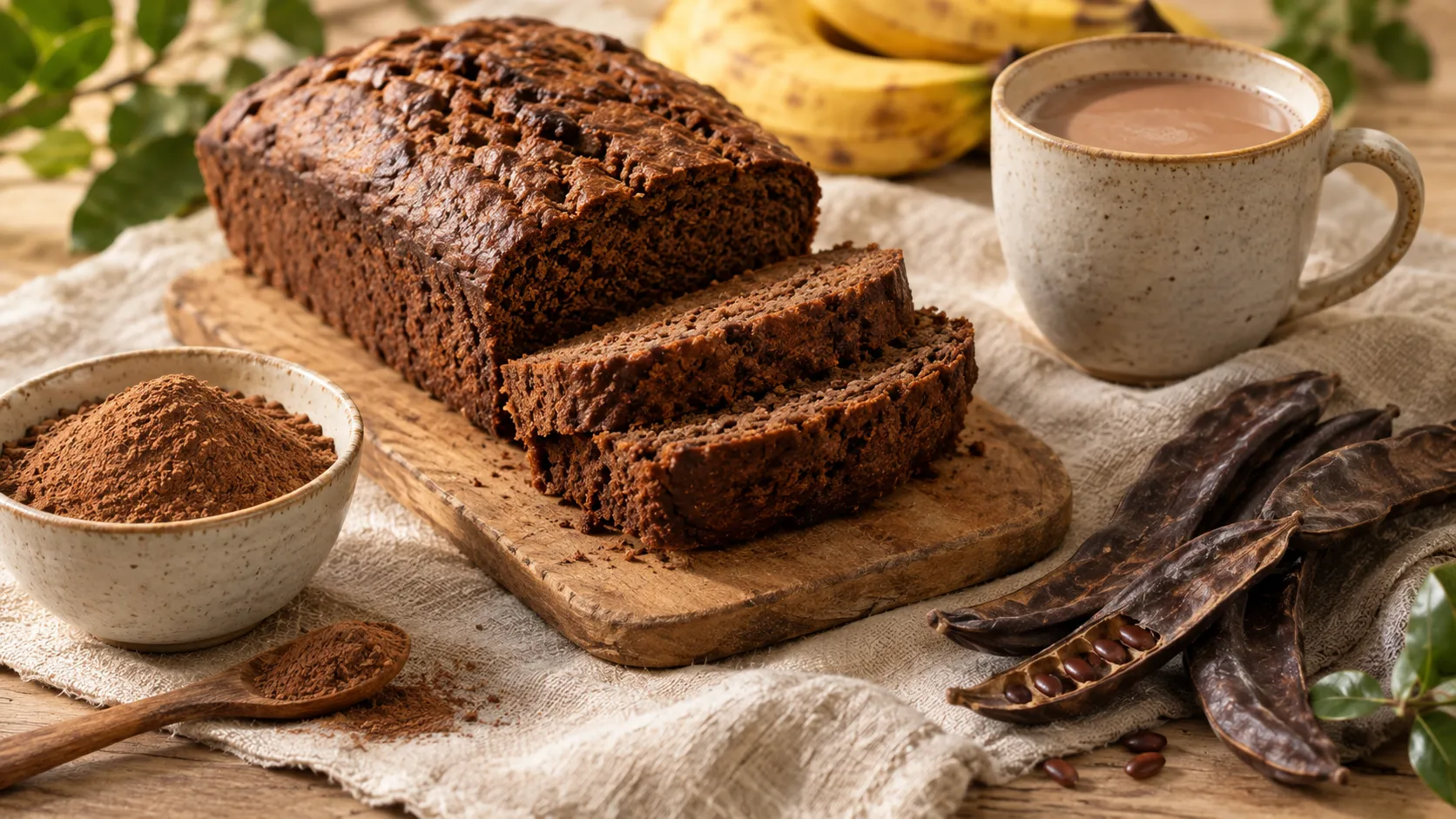
The easiest carob flour recipes use it alongside wheat flour, not instead of it: banana quick bread, soft cookies, a yeast loaf with 10% carob flour and a hot carob drink. Carob flour is naturally sweet but can’t build a loaf on its own, so keep it to a small share of the flour and taste before adding sugar.
Carob flour recipes: how to swap it in
Carob flour is the dried pulp of carob pods, seeds removed, ground into a fine brown powder. For carob powder, the pulp is usually ground, roasted and milled again, according to a 2022 review. Locust bean gum (E410), the thickener on ingredient lists, is a different product made from the seeds. We explain the naming in carob flour vs carob powder.
Carob or algarrobo? Check the pack
In English, carob means Ceratonia siliqua, a Mediterranean tree. In Peru, the algarrobo of the dry north coast is Prosopis pallida, a different tree whose sweet pods are also milled into flour. Both are sold in Peru as carob flour, and some packs name Ceratonia siliqua while others only give a Peruvian origin. That’s why our carob and algarrobo flour from Peru shows the tree or origin exactly as each pack states it.
Don’t assume one is sweeter than the other, because published sugar figures vary widely. USDA lists 49.1 g of sugars per 100 g of carob flour, an imputed value rather than a lab measurement. A 2020 lab analysis of Peruvian P. pallida flour found 18.3 g per 100 g of dry flour, mostly sucrose, yet the same paper cites an earlier analysis of P. pallida flour at about 48.5 g. It describes the flour’s aroma as close to coffee, cocoa, molasses and hazelnut. The two flours can behave differently in a recipe, so check the species on the pack and taste a pinch before you decide how much sugar to add.
Rules for swapping
| If the recipe has | Swap | Adjust | Why |
|---|---|---|---|
| Cocoa powder | The same weight of carob flour, as a starting point | Use less sugar, then taste the batter | Carob flour has about 49 g of sugars per 100 g; cocoa has under 2 g |
| Wheat flour in cakes, quick breads or cookies | Replace 20% to 25% of it, as a starting point | Add a splash more liquid if the batter looks stiff | Carob flour is about 40% fiber by weight |
| Wheat flour in yeast bread | Replace up to 10% of it | Keep the water about the same | In a 2020 baking study, going past 10% stopped improving the loaf |
Sources: USDA FoodData Central, carob flour (FDC 173755) and unsweetened cocoa powder (FDC 169593); Gonzales-Barron et al. 2020. The 1:1 cocoa swap and the 20% to 25% share are our starting points, not tested rules.
Carob won’t taste like chocolate. Expect a milder, caramel-like flavor. Cocoa also has about 20 times the fat of carob flour per 100 g, so carob bakes can taste leaner.
Carob flour vs cocoa powder, spoon for spoon
| Per tablespoon | Carob flour (6 g) | Unsweetened cocoa (5.4 g) |
|---|---|---|
| Calories | 13 | 12 |
| Sugars | 2.9 g | 0.1 g |
| Fiber | 2.4 g | 2.0 g |
| Fat | Under 0.1 g | 0.7 g |
| Calcium | 21 mg | 7 mg |
| Iron | 0.2 mg | 0.8 mg |
| Caffeine | 0 mg | 12 mg |
| Theobromine | 0 mg | 111 mg |
Source: our calculation from USDA FoodData Central values per 100 g (FDC 173755 and 169593) and USDA tablespoon weights, rounded. USDA lists carob’s caffeine and theobromine as zero by assumption, not by lab test.
Carob banana bread
A soft, not-too-sweet loaf, and the easiest way to try carob flour. It makes one 9 x 5-inch loaf, about 10 slices. Bake at 350°F (180°C) for 50 to 60 minutes.
Ingredients
- 3 very ripe bananas (about 350 g peeled)
- 190 g all-purpose flour (about 1½ cups)
- 60 g carob flour (½ cup plus 1½ tablespoons)
- 1 teaspoon baking soda
- ¼ teaspoon salt
- 1 teaspoon ground cinnamon (optional)
- 2 eggs
- 80 ml neutral oil (⅓ cup)
- 70 g brown sugar
- 60 ml milk or plant milk (¼ cup)
- 50 g chopped walnuts (optional)
Method
- Heat the oven and grease or line the loaf pan.
- Mash the bananas in a large bowl.
- Whisk in the eggs, oil, brown sugar and milk.
- In another bowl, mix the flours, baking soda, salt and cinnamon. Sift the carob flour if it has lumps.
- Fold the dry mix into the wet one until no streaks of flour remain. Don’t overmix. Stir in the walnuts.
- Bake until a toothpick comes out clean. Carob browns quickly, so cover the top loosely with foil if it darkens early.
- Cool for 10 minutes in the pan, then on a rack.
Carob flour is 24% of the flour here. By our math from USDA figures for Mediterranean carob, those 60 g can bring about 29 g of sugars, which is why the recipe uses less brown sugar than a typical banana bread.
Soft carob cookies
Soft cookies with a gentle, cocoa-like taste. Makes about 20. Bake at 350°F (180°C) for 10 to 12 minutes.
Ingredients
- 120 g all-purpose flour (about 1 cup)
- 30 g carob flour (5 tablespoons)
- ½ teaspoon baking soda
- A pinch of salt
- 85 g softened butter (6 tablespoons)
- 80 g brown sugar
- 1 egg
- 1 teaspoon vanilla extract
- 50 g raisins or chopped nuts (optional)
Method
- Heat the oven and line a baking sheet.
- Beat the butter and sugar until creamy, then beat in the egg and vanilla.
- Stir in the flours, baking soda and salt, then the raisins or nuts.
- Roll the dough into balls of about 20 g and flatten them slightly, leaving space between them.
- Bake until the edges are set and the centers still look soft.
- Leave them on the sheet for 5 minutes, then move them to a rack.
Carob flour is 20% of the flour. For a stronger carob taste, try 37 g of carob flour and 113 g of wheat flour next time.
Carob flour bread: a yeast loaf with 10% carob
This is the one recipe here with research behind its ratio. In a 2020 baking study, researchers replaced 5%, 10% and 15% of the wheat flour with Peruvian P. pallida flour. Up to 10%, loaves rose higher and the crumb was softer than plain wheat bread. Above 10%, the loaves stopped getting bigger, and with one of the two wheat flours they got smaller again, though still bigger than plain wheat bread. The study used algarrobo flour; with Mediterranean carob flour, 10% is a sensible place to start, but it wasn’t tested.
Makes one 9 x 5-inch loaf. Bake at 425°F (220°C) for 30 to 35 minutes.
Ingredients
- 450 g bread flour
- 50 g carob flour (10% of the flour)
- 7 g instant dry yeast (one packet)
- 8 g fine salt (about 1⅓ teaspoons)
- 300 ml lukewarm water
- 1 tablespoon oil (optional)
Method
- Mix the flours, yeast and salt in a large bowl.
- Add the water and oil and mix into a shaggy dough.
- Knead for about 10 minutes, until smooth and springy. If it feels stiff, add 1 to 2 tablespoons more water.
- Cover and let it rise until doubled, about 60 to 90 minutes.
- Shape it into a log and place it in the greased pan.
- Let it rise again for 30 to 45 minutes, until it domes over the rim.
- Bake until deep brown and hollow-sounding when you tap the bottom. Cover loosely with foil if the top darkens too early. Cool before slicing.
The water here is 60% of the flour weight, close to the 59.1% the researchers used. They baked small 230 g loaves in tins at 446°F (230°C) for 40 minutes in a convection oven, so this home version is our adaptation.
Hot carob drink
Stirring carob flour into hot or cold milk is a use described in Julia Morton’s Fruits of Warm Climates, a reference hosted by Purdue University. Makes 1 mug in 5 minutes.
Ingredients
- 240 ml milk or plant milk (1 cup)
- 1 to 2 tablespoons carob flour (6 to 12 g)
- A pinch of cinnamon
- ½ teaspoon honey or sugar (optional, taste first)
Method
- In a mug, stir the carob flour with 2 tablespoons of the milk into a smooth paste.
- Heat the rest of the milk until steaming, without boiling.
- Whisk in the paste and the cinnamon. Strain if any lumps remain.
Two tablespoons of carob flour add about 27 calories, 6 g of sugars and 5 g of fiber, by our math from USDA figures. Carob has no caffeine or theobromine, according to the 2022 review, while a tablespoon of unsweetened cocoa has about 12 mg of caffeine and 111 mg of theobromine. For what carob does and doesn’t do beyond that, read what carob flour does and doesn’t do for your health.
Storing carob flour and your bakes
Keep carob flour in a well-closed container somewhere cool and dry, and go by the date on the pack. Fiber-rich flours pick up moisture, so close the bag or jar right after use. Store the banana bread and cookies covered at room temperature, and freeze slices you won’t eat soon, well wrapped.
Frequently asked questions
Can you make bread with only carob flour?
Not a raised loaf. Wheat flour forms the stretchy dough that traps gas from the yeast, and carob flour doesn’t do that. For a carob flour bread that rises, keep wheat flour as the base and use carob as a small share of the flour, as in the yeast loaf above.
Is carob powder healthier than cocoa powder?
They’re different rather than better or worse. Per tablespoon, carob has more sugar and calcium and almost no fat, while cocoa has more iron plus caffeine and theobromine. If you’re avoiding caffeine, carob fits. If you’re watching sugar, cocoa has less. The spoon-for-spoon table above has the numbers, and our carob flour nutrition facts go further.
What are some ways to use carob powder?
Beyond these four recipes, stir it into oatmeal, smoothies or yogurt, or use it in brownies, muffins and pancakes in place of some or all of the cocoa. Crushed pods can also be boiled in water into a thick, honey-like syrup, according to Morton. Start with a spoonful or two and adjust from there.
Does Peruvian algarrobo flour work in the same recipes?
Yes, with the same rules as above: a small share of the flour and less sugar to start. Algarrobo (Prosopis pallida) and Mediterranean carob (Ceratonia siliqua) come from different trees, so the two flours can behave differently in a recipe. Check the pack to see which one you have, and adjust after your first bake.
Are these carob recipes gluten-free?
No. The three bakes use wheat flour, so they contain gluten; only the hot drink is wheat-free. If you avoid gluten, choose a carob flour labeled gluten-free and a gluten-free flour blend; some gluten-free carob recipes use buckwheat or oat flour. Expect a different texture: without gluten the loaf won’t rise the same way, and these recipes were written for wheat flour, so a gluten-free version needs its own adjustments.
Shop carob and algarrobo flour
We buy carob and algarrobo flour in Peru, read the label for the species, and ship it to you.
- Out of stock
Sources
- USDA Agricultural Research Service, 2019. Carob flour (FDC ID 173755). FoodData Central, SR Legacy.
- USDA Agricultural Research Service, 2019. Cocoa, dry powder, unsweetened (FDC ID 169593). FoodData Central, SR Legacy.
- Gonzales-Barron U, Dijkshoorn R, Maloncy M, et al., 2020. Nutritive and bioactive properties of mesquite (Prosopis pallida) flour and its technological performance in breadmaking. Foods 9(5):597.
- Gioxari A, Amerikanou C, Nestoridi I, et al., 2022. Carob: a sustainable opportunity for metabolic health. Foods 11(14):2154.
- Morton J, 1987. Carob. In: Fruits of Warm Climates, pp. 65–69. Julia F. Morton, Miami, FL; online at Purdue University NewCROP.