The short answer
No. No study has tested whether maca makes your butt bigger. In a 12-week trial, body mass index didn’t differ from placebo, and in trials that measured hormones, levels mostly stayed the same. The idea comes from social media and “curvy” supplement marketing. What does build your glutes is regular resistance training, with enough protein, over weeks to months.
Does maca make your butt bigger? Why the answer is no
Butt, bum or booty, the answer is the same, and it doesn’t change with the color of the maca. The size of your buttocks comes down to two things: the gluteal muscles and the fat on top of them. To change it, something has to build muscle or change where your body stores fat. Maca hasn’t been shown to do either.
No study has measured maca and glute size
No published study has looked at maca and the size of the buttocks or hips. When we searched PubMed in October 2026 for maca together with buttocks, gluteal muscles, hips or body composition, nothing on the question came up, not even a study in animals. So every claim about maca root for buttocks growth rests on personal stories.
What trials found on hormones and weight
The usual theory is that maca shifts hormones, and hormones shape your curves. When researchers have measured hormones, they mostly didn’t move. Among the studies listed by LiverTox, an NIH database, one in 56 men found that sex and pituitary hormone levels stayed the same on maca, and a small pilot study in postmenopausal women found no change in hormone levels either.
For body size, the main data come from a 12-week trial in Peru: 175 adults took 3 g a day of red or black maca extract, or a placebo, and body mass index didn’t differ from placebo with either color. Beyond weight and hormones, LiverTox notes that maca’s claimed benefits as a whole are unproven in well-controlled human trials.
Where the “maca for curves” idea comes from
Most of what you’ll find on this question is personal posts: before-and-after photos, videos and product reviews. Alongside them are home recipes that mix maca powder with other seeds and oils, and capsules sold “for curves” that combine maca with several other herbs. We found no published trial on body shape for any of these products.
The hormone story sounds plausible because part of it is true. Sex hormones do affect where your body stores fat. A 2012 review explains that, at the same body mass index, women carry more fat under the skin, including around the hips and thighs, and that this fat tends to move toward the belly after menopause, probably because estrogen falls. The missing step is maca itself: the trials above give no good evidence that it shifts those hormones.
Red, black or yellow maca for curves?
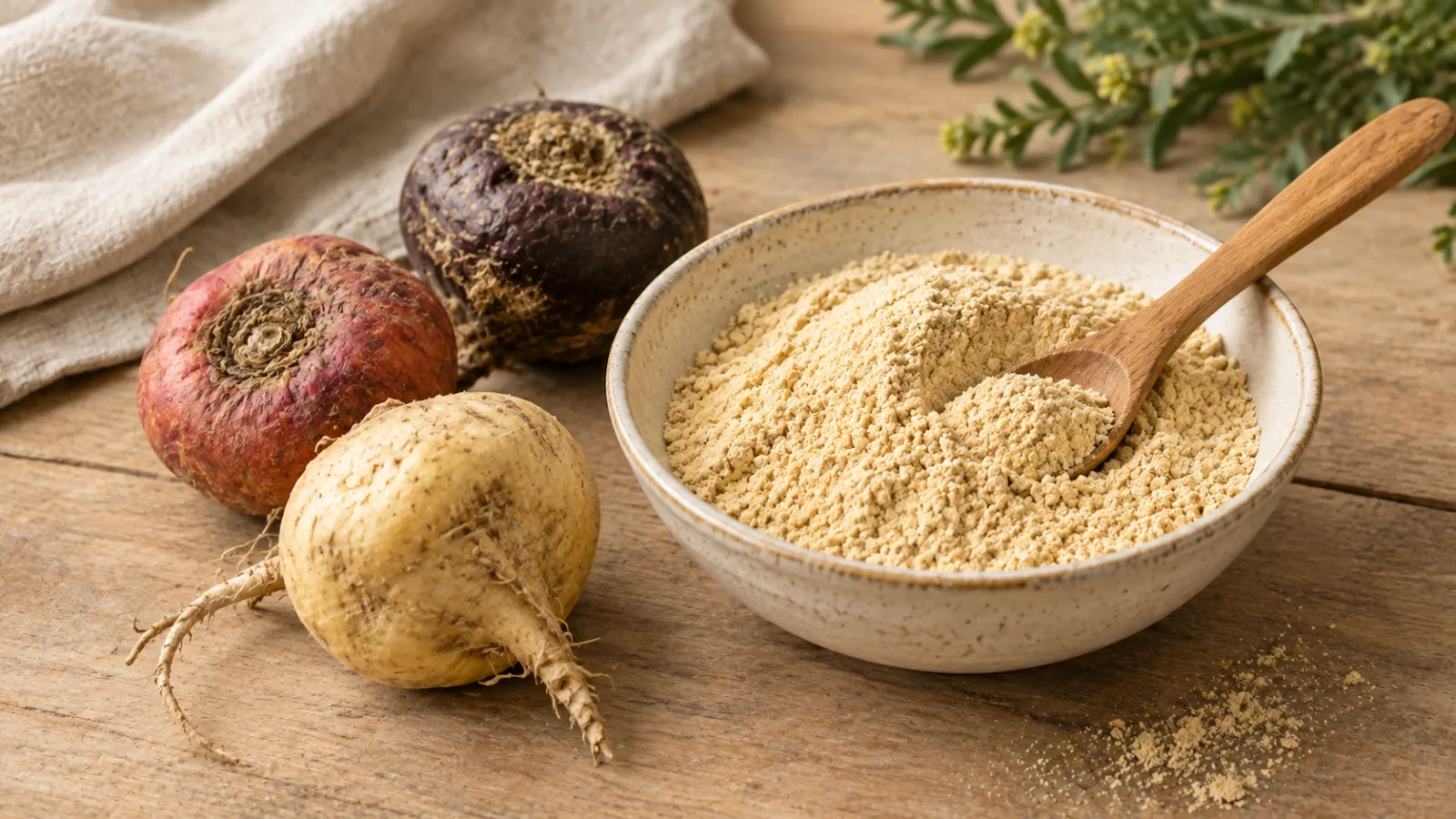
No color of maca has been tested for body shape, so no color has an edge for curves. The one trial that compared colors in people gave red or black maca extract to adults for 12 weeks. Both improved self-rated mood and energy more than placebo near sea level (Gonzales-Arimborgo 2016). Yellow maca wasn’t part of that trial.
Red maca for curves
Red maca is often marketed to women, including as a way to a bigger booty. Its research in people is that one trial, on mood and energy, and none of it touched body shape. We go through what red maca has been studied for in a separate post.
Black maca for curves
Black maca research has focused mostly on men’s sexual health and on studies in animals. None of it measured the buttocks or hips. For the details, see the research on black maca.
What maca has actually been studied for
If you’re wondering what maca does in the female body, or in anyone’s, the honest answer is that very little has been proven. Here is what trials in people have measured.
| What was measured | Who was studied | What was found | Related to glute size? |
|---|---|---|---|
| Sexual desire and function | 4 small trials, 131 people | Limited evidence of benefit | No |
| Mood and energy | 175 adults, 12 weeks, red or black maca extract | Better than placebo near sea level | No |
| Body mass index | Same trial | No different from placebo | No |
| Sex and pituitary hormones | 56 men | No change | No |
| Hormones after menopause | Small pilot study in postmenopausal women | No change | No |
| Size of buttocks, hips or breasts | No study found | Nothing to report | Yes |
Sources: Shin 2010 (systematic review); Gonzales-Arimborgo 2016; LiverTox 2019.
The sexual function data come from a 2010 systematic review of four small randomized trials, which the authors judged too limited for firm conclusions.
What actually changes the size of your glutes
If your goal is bigger glutes, the research points to training first, then food. Here is what it shows.
Muscle: resistance training
A 2025 systematic review and meta-analysis found 12 studies in 318 adults aged 18 to 45, including 144 women, and pooled 11 of them. Resistance training had a moderate effect on the size of the gluteus maximus, the largest muscle of the buttocks. The programs lasted 5 to 24 weeks, with 1 to 3 sessions a week. Hip thrusts, squats, leg presses and hip extensions all produced growth in at least one study, though leg press results were mixed. The authors favor barbell hip thrusts when the glutes are the priority, and squats at least to parallel. In one of the studies, full squats grew the muscle by 6.7% compared with 2.2% for half squats. The studies were small and of moderate quality, so treat these as averages, not promises.
Protein, alongside training
In people who lift, extra protein helps a little. A 2018 meta-analysis of 49 trials in 1,863 adults doing resistance training found that extra protein added about 0.3 kg of lean mass across the whole body, and about 2.5 kg to the heaviest weight people could lift once. Above roughly 1.6 g of protein per kilogram of body weight a day, there was no further gain.
Body fat: sex, age and genes
The fat part of your shape is harder to steer. The 2012 review notes that where you store fat differs between women and men, shifts after menopause, and is partly inherited: twin studies put up to 70% of the variation in body mass index down to genes. You can’t choose where your body adds or loses fat.
| Factor | What it changes | What the research shows |
|---|---|---|
| Resistance training | Glute muscle size | Moderate average growth across 11 pooled studies, over 5 to 24 weeks |
| Protein while training | Muscle mass and strength | About 0.3 kg more lean mass on average; no extra gain above about 1.6 g/kg a day |
| Sex hormones and age | Where fat is stored | More hip and thigh fat in women; shifts toward the belly after menopause |
| Genes | Body size and fat pattern | Up to 70% of the variation in body mass index in twin studies |
| Maca | Nothing shown | No study found on glute or hip size |
Sources: Krause Neto 2025; Morton 2018; Karastergiou 2012; for maca, our PubMed search in October 2026.
Is it safe to take maca every day?
In short trials, maca seems to be well tolerated. LiverTox describes maca’s side effects as uncommon and mild, mostly stomach upset and headaches, and finds no convincing reports of liver injury. In the 12-week Peru trial, 3 g a day of extract caused no serious side effects. The trials we cite lasted 12 weeks or less, so there’s little data on taking it daily for longer.
If you’re pregnant or breastfeeding, take prescription medicine or have a health condition, there isn’t enough safety data on maca supplements. Talk to your doctor before you start.
Frequently asked questions
Does maca make your hips or breasts bigger?
There’s no evidence that it does. We found no study that measured hip or breast size in people taking maca. The theory relies on maca raising hormones, which trials in people haven’t consistently shown. Hip size depends largely on body fat, and where your body stores fat follows your sex, age and genes.
Can maca make you gain weight, or gain it in your stomach?
Not in the research so far. In the 12-week trial of 175 adults, body mass index didn’t differ from placebo with either red or black maca. The studies used a few grams a day. We look at this question in more detail in maca and weight gain.
Which supplement is best for glute growth?
None works on its own. In the 2018 meta-analysis, protein supplements added a small amount of muscle in people doing resistance training, about 0.3 kg of lean mass on average across the whole body. The training itself is what grew the gluteus maximus in the 2025 meta-analysis. A supplement can only add a little on top of that.
How long does it take to see glute growth from training?
The programs in the 2025 meta-analysis ran from 5 to 24 weeks, with 1 to 3 sessions a week, and the average effect on glute size was moderate. How fast you see a change depends on your starting point, your training and your food, so the research can’t give you a personal timeline.
Are “curvy” maca pills worth it?
We found no published trial showing that any “curvy” or “booty-boosting” supplement changes body shape. These products often combine maca with several other herbs, which makes it harder to know what you’re taking and how much of each. If glute size is your goal, the training and protein research above is a better place to start.
Shop Peruvian maca powder
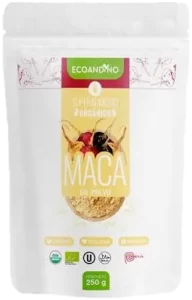
If you want maca as a food, for your breakfast or smoothies, here’s the maca powder we bring from Peru.
- Best seller
Sources
- National Institute of Diabetes and Digestive and Kidney Diseases, 2019. Maca. LiverTox: Clinical and Research Information on Drug-Induced Liver Injury.
- Gonzales-Arimborgo C, Yupanqui I, Montero E, et al., 2016. Acceptability, Safety, and Efficacy of Oral Administration of Extracts of Black or Red Maca (Lepidium meyenii) in Adult Human Subjects: A Randomized, Double-Blind, Placebo-Controlled Study. Pharmaceuticals.
- Shin BC, Lee MS, Yang EJ, et al., 2010. Maca (L. meyenii) for improving sexual function: a systematic review. BMC Complementary and Alternative Medicine.
- Krause Neto W, Krause TLV, Gama EF, 2025. The impact of resistance training on gluteus maximus hypertrophy: a systematic review and meta-analysis. Frontiers in Physiology.
- Morton RW, Murphy KT, McKellar SR, et al., 2018. A systematic review, meta-analysis and meta-regression of the effect of protein supplementation on resistance training-induced gains in muscle mass and strength in healthy adults. British Journal of Sports Medicine.
- Karastergiou K, Smith SR, Greenberg AS, Fried SK, 2012. Sex differences in human adipose tissues: the biology of pear shape. Biology of Sex Differences.