The short answer
Maca root for female fertility is unproven. A 2018 review found no clinical trial showing maca helps women conceive, and a later trial of a maca-containing blend found no difference in pregnancies. A mouse study found larger litters, but nothing links maca to twins, and its safety in pregnancy is unknown.
Maca root and female fertility: can it help you get pregnant?
Does maca root help you get pregnant? Not on current evidence. When two researchers at University College London’s School of Pharmacy reviewed the reproductive claims made for maca in 2018, they wrote that, as far as they knew, no clinical trial had been done to test maca’s effect on fertility in women (Beharry and Heinrich 2018). Their overall verdict on maca’s reproductive claims was that the evidence is “too limited.”
Since then, the only trial we found that counted pregnancies tested a proprietary blend containing maca extract, in women with disorders of the hormone signals that control the ovaries. Pregnancy rates did not differ between groups, according to a 2024 review of maca research. So for maca root and women’s fertility, the honest summary is “not tested well enough to know.”
What about maca root pregnancy success stories online? They are real experiences, but they can’t separate maca from everything else going on: time, age, medical treatment and plain chance. Only a controlled trial can do that, and none has been published for maca alone.
| Question | Who was studied | What was found |
|---|---|---|
| Does maca help women get pregnant? | No trial of maca alone; one trial of a blend with maca | No difference in pregnancies with the blend |
| Does it change litter size? | Female mice given yellow maca extract | More pups per litter; same number of implanted embryos |
| Does it change hormone levels? | Small trials in women around menopause | No consistent change |
| Does it change the cycle? | Rodents; case reports in women | No change in rodent cycles; one case of unexpected vaginal bleeding |
| Does it help sexual function? | 42 women with sexual side effects from antidepressants | Small improvement, better after menopause |
| Does it cause twins? | No study | No evidence |
| Is it safe in pregnancy? | No human data; one animal study | Unknown in people |
Sources: Beharry and Heinrich 2018; Ulloa del Carpio 2024; Ruiz-Luna 2005; Minich 2024; Dording 2015.
Why maca is linked to fertility
The reputation comes from the Andes. In Peru, maca has long been eaten as food and used as a tonic and a fertility aid, for people and for livestock (Beharry and Heinrich 2018). The 2024 review notes an old colonial-era account of women who could not conceive eating maca, and adds that this “has not been proven.” As demand grew outside Peru, online sellers marketed it as “Peruvian ginseng” for libido and fertility.
The idea has stuck. In a survey of 95 women seeking fertility treatment, maca was among the herbal supplements they commonly used, and 71.4% of those taking it did so for fertility (Minich 2024). Use is far ahead of the evidence. In Peru, maca is mostly eaten as a food, which is how many people still use Peruvian maca powder.
How maca is thought to work, and what studies measured
How does maca help fertility, in theory? The usual claim is that it acts on the hormone signals between the brain and the ovaries. In people, when researchers have measured, the hormones mostly don’t move: the 2024 color review says clinical studies lasting weeks or months have not shown significant effects on hormones. In rodents, some hormone levels rose with maca, but the estrous cycle, the animal version of the menstrual cycle, didn’t change (Beharry and Heinrich 2018).
In mice: bigger litters
The study most often behind fertility claims was done in mice. In Ruiz-Luna 2005, female mice got an extract of yellow maca, 1 g per kg of body weight, from 15 days before mating through pregnancy and nursing. They had more pups per litter at birth. But the number of embryos that implanted in the womb was not significantly different, about 11.6 with maca vs 9.7 without, and pregnancy length was the same. The authors suggested fewer embryos were lost, but they didn’t measure that. It is one mouse study, and the authors did not test anything in women.
In women: menopause and sexual function, not fertility
The trials in women looked at other questions. Small trials in women around menopause, listed in the 2024 review of maca research, reported fewer symptoms, but hormone results were inconsistent. In a 12-week trial of 42 women with sexual side effects from antidepressants, 3 g of maca a day led to slightly more women recovering normal sexual function than placebo, 9.5% vs 4.8% on one scale, with better results in women past menopause. None of these trials measured ovulation or pregnancy, so they can’t tell you anything about conceiving.
Does maca root cause twins?
We found nothing linking maca to twins. No study in women has looked at it, and none of the reviews we read mentions it. The idea may come from the mouse study above, where maca-fed mice had bigger litters. A mouse litter is not a pair of twins, though. In that study the number of implanted embryos was not significantly different with maca, and pregnancy length didn’t change (Ruiz-Luna 2005). And in female rats, none of three maca colors changed the number of eggs released (Beharry and Heinrich 2018). If you have read about taking maca root for twins, those maca root twins stories are anecdotes, with no study behind them.
Red, black or yellow maca for fertility?
No study in women has compared maca colors for fertility. In the one animal study we found that compared them, in female rats, extracts of red, yellow and black maca didn’t change the estrous cycle or the number of eggs released (Beharry and Heinrich 2018). “Red maca for women, black maca for men” is a marketing shorthand, not a research finding. Here is what else the color studies measured:
- Red maca: no fertility study in women, and no effect on the cycle or ovulation in the rat study above. In rats with their ovaries removed, red and black maca protected bone; that is about menopause, not conceiving (Minich 2024). Red maca powder for fertility, organic or not, has nothing behind it beyond tradition. Our post on what studies show about red maca root covers the rest.
- Black maca: in animal studies, it’s the color with the strongest effect on sperm production (Minich 2024). That is male fertility. In women, no study has tested black maca root for fertility, and in the rat study above it didn’t change the cycle or ovulation.
- Yellow maca: the color used in the mouse litter study, which is not evidence for women either.
One more caution: these color studies and the mouse litter study were all done by the same research group in Lima, led by Gustavo F. Gonzales, so independent labs still need to confirm them.
When to stop taking maca when trying to conceive
No study tells you when to stop, because maca hasn’t been tested in pregnancy. Neither the 2018 review nor the 2024 review reports any study of maca in pregnant women. The 2024 review’s only pregnancy-safety data come from one study in animals, which found no changes in embryonic development.
So this comes down to caution, not data. Talk to your doctor before you start trying to conceive if you take maca. The cautious option is to stop when you start trying, since you won’t know right away that you are pregnant. At the latest, stop as soon as you have a positive test. For more, read our post on maca during pregnancy.
Side effects and who should check first
In short trials, maca is usually well tolerated. LiverTox, an NIH database on liver injury from drugs and supplements, names digestive symptoms and headaches as the main side effects and calls them uncommon and mild. The 2024 review of maca research lists one case of vaginal bleeding in a 24-year-old woman, which matters if you are tracking your cycle, and headache, stomach upset and irritability in a trial at 3 g a day.
Check with a doctor first if you are breastfeeding (see maca while breastfeeding), take medication or have a health condition. The 2024 color review says maca should be avoided by anyone with a history of hormone-sensitive cancer. Its authors also describe, from clinical experience rather than a study, women with polycystic ovary syndrome whose symptoms worsened on blends heavy in black maca. See what’s known about maca and PCOS.
What about the male partner?
The evidence in men is a little larger and still mixed. In trials listed in the 2024 review of maca research, 65 men with mildly low sperm quality took 2 g a day for 12 weeks: sperm concentration rose, but motility and shape did not change. In 50 men with infertility, gelatinized yellow maca for 16 weeks made no difference compared with placebo. We cover the black maca research in black maca and men’s fertility.
Frequently asked questions
How much maca do women take to get pregnant?
There’s no studied amount for female fertility, because the trials haven’t been done. In maca trials on other questions, people usually took 2 to 3 g a day for about 12 weeks, according to the 2024 review of maca research, and the women’s trial above used 3 g a day. Those are amounts researchers used, not a recommendation for anyone trying to conceive.
How fast does maca root work for fertility?
Nobody knows, because no study has measured time to pregnancy with maca. The trials in women ran from a few weeks to several months and measured menopause symptoms or sexual function, not conception. If you read that maca “works in three months,” that timeline doesn’t come from a fertility study.
Does maca regulate your period or ovulation?
That hasn’t been shown. In female rats, maca extracts didn’t change the cycle or the number of eggs released, and no human trial has measured ovulation. In women, the 2024 review of maca research lists one case of unexpected vaginal bleeding as a possible side effect. If your cycle changes while you take maca, tell your doctor.
Can I take maca during IVF or other fertility treatment?
There are no studies of maca during IVF or other fertility treatment. Your clinic will be tracking hormones and timing closely, so tell your care team about maca, and any other supplement, before you start. They can tell you whether to pause it.
Is any herb proven to help women get pregnant?
For maca, no: the reviews call the evidence too limited. We haven’t reviewed the evidence for other herbs here, so we won’t rank them. A fertility specialist can tell you which supplements have a clear role before and during pregnancy, and which ones don’t.
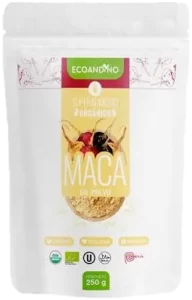
Shop Peruvian maca powder
If you use maca as a food, here is the maca powder we buy in Peru and ship from Lima.
Sources
- Beharry S, Heinrich M, 2018. Is the hype around the reproductive health claims of maca (Lepidium meyenii Walp.) justified? Journal of Ethnopharmacology.
- Ruiz-Luna AC, Salazar S, Aspajo NJ, Rubio J, Gasco M, Gonzales GF, 2005. Lepidium meyenii (Maca) increases litter size in normal adult female mice. Reproductive Biology and Endocrinology.
- Ulloa del Carpio N, Alvarado-Corella D, Quiñones-Laveriano DM, et al., 2024. Exploring the chemical and pharmacological variability of Lepidium meyenii: a comprehensive review of the effects of maca. Frontiers in Pharmacology.
- Minich DM, Ross K, Frame J, et al., 2024. Not All Maca Is Created Equal: A Review of Colors, Nutrition, Phytochemicals, and Clinical Uses. Nutrients.
- Dording CM, Schettler PJ, Dalton ED, et al., 2015. A Double-Blind Placebo-Controlled Trial of Maca Root as Treatment for Antidepressant-Induced Sexual Dysfunction in Women. Evidence-Based Complementary and Alternative Medicine.
- National Institute of Diabetes and Digestive and Kidney Diseases, 2019. Maca. LiverTox: Clinical and Research Information on Drug-Induced Liver Injury.