The short answer
How to grow quinoa: sow seed of a named garden variety in early spring, 1/4 to 1/2 inch deep, in a sunny, well-drained bed, then thin plants to 3 to 12 inches apart. Expect plants 3 to 6 feet tall and 90 to 150 days to harvest. Pick a site where flowering won’t meet heat above 95°F.
Growing quinoa at a glance
Quinoa is an annual crop from the Andes. It belongs to the Amaranthaceae family, along with spinach, beets and the common weed lambsquarters, according to Washington State University Extension.
| What | Guideline |
|---|---|
| Sun and soil | Full sun, well-drained soil; best near neutral pH, tolerates pH 4.5–9 |
| When to sow | Early spring, as soon as the soil can be worked, close to the last frost |
| Soil temperature | Nearly 100% germination at 36–68°F (2–20°C) |
| Germination | Seeds sprout in about 24 hours; seedlings emerge in 3–5 days |
| Depth | 1/4 to 1/2 inch |
| Spacing | Rows 8–24 in apart; thin to 3–5 in (up to 12 in) |
| Plant height | 3–6 ft |
| Flowering | 40–80 days after sowing |
| Days to harvest | 90–150, depending on variety |
| Heat limit | Above 95°F (35°C) at flowering can leave plants without seed |
| Cold | Young plants with two leaves handle 25°F (−4°C); frost at flowering cuts yield |
Sources: WSU Extension FS258E (Kellogg and Murphy, 2017); Utah State University Extension, Quinoa for Utah (2017). Full links below.
Can you grow quinoa where you live?
Yes, you can grow quinoa in many places. For an annual, winter cold doesn’t matter. Heat during flowering does.
Quinoa growing zones
USDA hardiness zones are based on the average lowest winter temperature. Quinoa is sown in spring and harvested before winter, so your zone number tells you little. What matters is when it flowers, 40 to 80 days after sowing. Utah State University Extension warns that pollen can become sterile above 95°F. In dryland eastern Washington, heat above 95°F during flowering wiped out the seed crop (WSU). Regions with cool summers suit it best.
Can quinoa be grown in the US?
It can. WSU reports harvests from sea level on Washington’s Olympic Peninsula up to 7,600 feet in Colorado’s San Luis Valley.
Choose the right seed
Can you plant quinoa from the grocery store? WSU says store-bought quinoa is “typically unsuitable for planting.” It likely contains short-day varieties grown in Bolivia and Peru that may not mature in a northern climate. Buy seed of a named variety instead. Varieties suited to places like the Pacific Northwest need long days and cool summers, according to WSU. In its Washington trials, Kaslaea and Colorado 407 Dave were among the higher yielders.
How to grow quinoa from seed
To plant quinoa seeds, follow these steps from WSU and Utah State.
- Pick the site. Full sun and good drainage.
- Sow early. Plant in early spring, as soon as the soil can be worked and close to your last frost. Seed germinates in soil as cool as 36°F.
- Sow shallow. Cover the seed with 1/4 to 1/2 inch of fine soil. Deeper sowing gives patchy emergence.
- Space the rows. Rows 8 to 24 inches apart. WSU suggests 5 to 8 g of seed (1 to 2 teaspoons) per 100 square feet.
- Thin. About two weeks after the seedlings come up, thin them to 3 to 5 inches, or up to 12 inches for bushier plants.
- Or transplant. Start seed in trays and plant out when seedlings have 3 or 4 true leaves, 12 inches apart.
Quinoa seedlings vs lambsquarters
A quinoa seedling and a lambsquarters seedling look almost identical. Sow in straight rows so you can tell your crop from the weeds. Lambsquarters can also cross-pollinate with quinoa, so pull it before it flowers if you plan to save seed (WSU).
Caring for quinoa as it grows
- Water: where dryland crops grow, quinoa can manage without irrigation, but flowering and seed filling need moist soil. In hot, dry summers, extra water raises yields (WSU).
- Feeding: test the soil first. Too much nitrogen delays ripening, makes leafy plants and can cause them to fall over (WSU).
- Weeds: no herbicides are registered for quinoa in the US (Utah State), so weed by hand or hoe, or use mulch.
Pests and diseases
Downy mildew is the most damaging disease in rainy areas. It’s carried on seed and can take nearly the whole crop, WSU warns. Give plants room and avoid wetting the leaves with overhead watering. Aphids and lygus bugs are the main insect pests (Utah State).
How to harvest quinoa
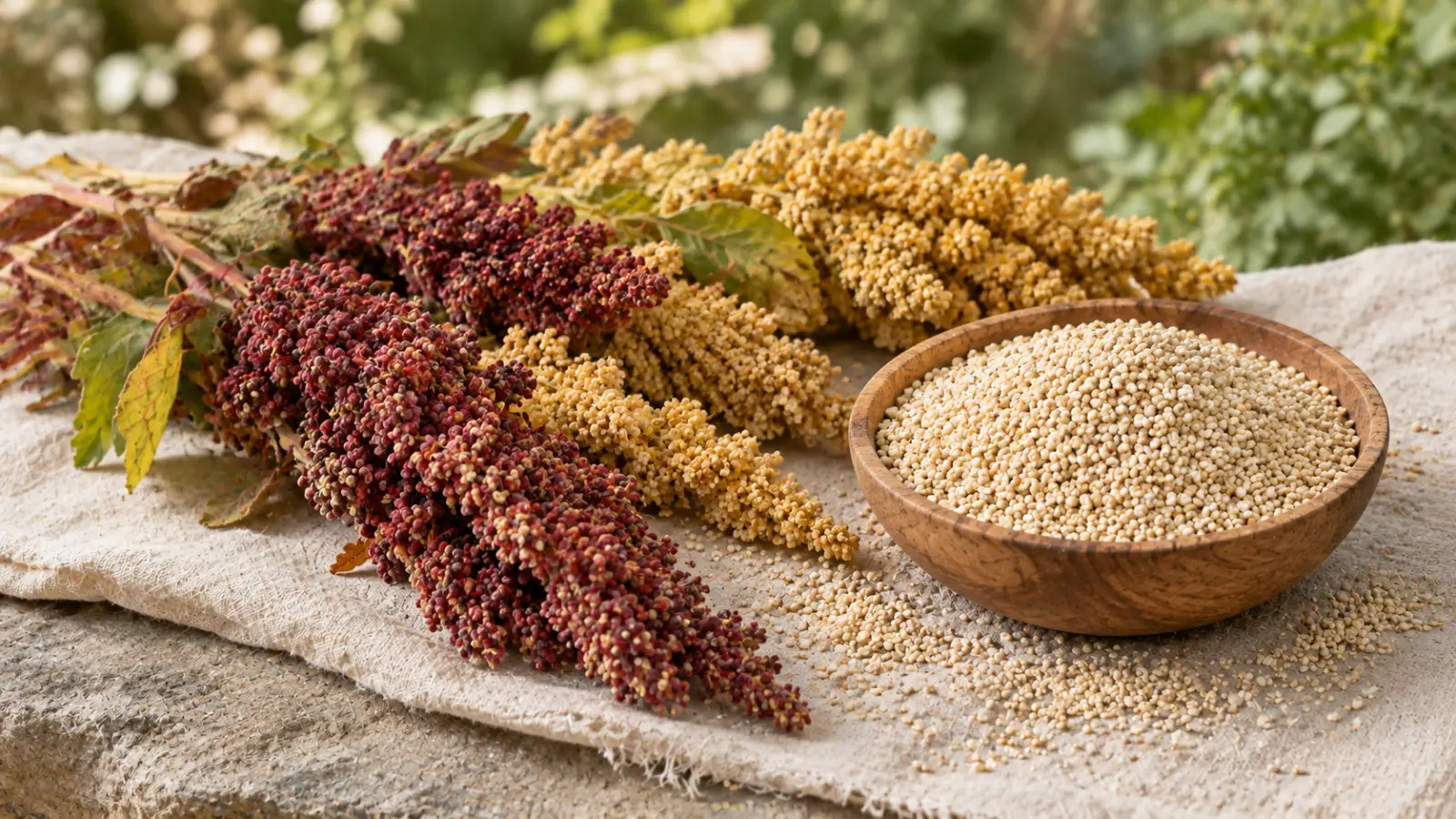
How do you harvest quinoa? Watch the leaves first. In late summer they turn yellow, red or pink and start to drop. The seed is ready when you can barely dent it with a fingernail (WSU). Cut the heads with pruners. Plants with several heads can be picked in stages.
Don’t let ripe quinoa sit in the rain: WSU warns a mature crop can be completely lost if it’s rained on. If rain is forecast, cut the heads and dry them under cover.
Threshing and winnowing
Once the heads are dry, beat them against a hard surface, rub them between your hands, or hit them with a stick over a clean sheet or tarp. Then pour the seed in front of a fan so the chaff blows away, and use a screen to remove larger bits. Dry the seed in the sun for a few days, to about 13% moisture (WSU).
Washing off the saponins
Homegrown quinoa is coated in saponins, which taste bitter and soapy. Soak the seed, stir and drain it. Repeat until the water no longer foams. You can also rinse it several times under hot running water, or toast it in a pan and then rinse it until the water runs clear (WSU). Clean quinoa cooks like store-bought; here’s what a cup of quinoa gives you.
Storing your harvest
Keep the dry grain airtight and see how long dry quinoa keeps. Seed for next year’s planting can last up to 20 years in a dark place at about 50°F (WSU).
How quinoa farming works in Peru
In Peru, quinoa is grown from sea level to about 4,000 meters (13,100 feet), according to the FAO and La Molina National Agrarian University’s growing guide.
| Zone | Altitude | Sowing months |
|---|---|---|
| Coast | 0–500 m (up to about 1,600 ft) | June–August |
| Inter-Andean valleys | 2,500–3,500 m (about 8,200–11,500 ft) | November–December |
| High sierra | 3,500–3,800 m (about 11,500–12,500 ft) | October–November |
| Altiplano, around Lake Titicaca | 3,800–4,000 m (about 12,500–13,100 ft) | September–October |
Source: Gómez Pando and Aguilar Castellanos, Guía de cultivo de la quinua, FAO/UNALM, 2016 (normal years).
Puno, on the shores of Lake Titicaca, produced about 68% of Peru’s quinoa in 2012. Ayacucho, Cusco, Apurímac, Junín and Arequipa followed (FAO and CIRAD, 2014). In the highlands, sowing waits for the rains, which usually arrive in October or November.
How is quinoa harvested in the Andes? On the altiplano it’s done by hand. Farmers cut plants with a sickle 10 to 15 cm (4 to 6 inches) above the ground and stand them in crossed stacks called arcos, where they dry in under three weeks. They thresh by beating the plants with a stick, then winnow the grain. Traditionally the bitterness is removed by heating the grain and then washing it (FAO and PROINPA, 2011). Some Peruvian quinoa is later milled into quinoa flour. The boom in demand has had side effects too, which we look at in the environmental and social side of the quinoa boom.
Frequently asked questions
Is quinoa easy to grow?
Sprouting is easy: seeds germinate in about a day (WSU). A good grain harvest is harder. Heat at flowering, rain on ripe plants, downy mildew and lygus bugs can all cut the crop, and you have to wash off the saponins afterward.
Does quinoa come back every year?
No. Quinoa is an annual crop (Utah State University Extension), so the plant dies after it sets seed. You’ll need to sow again each spring, either with seed you saved and dried to about 13% moisture or with fresh seed from a seed company.
Can you grow quinoa in pots?
Yes, but go big. Plants can reach 3 to 6 feet, so use a large, deep container in full sun. WSU’s main warning for containers is not to over-fertilize. Heat matters as much in a pot as in the ground: if flowering hits days above 95°F, plants may set little or no seed.
Can you eat quinoa leaves?
Yes. WSU notes that young quinoa leaves can be eaten like baby spinach, and some gardeners grow quinoa just as a leafy green. If you’re growing it for grain, pick only a few leaves per plant, because taking a lot of them reduces the seed harvest.
Shop Peruvian quinoa flour
Not growing your own? We buy quinoa flour in Peru, read the label and ship it to you from Lima.

Sources
- Kellogg JA, Murphy KM, 2017. Grains: Growing quinoa in home gardens. Washington State University Extension, FS258E.
- Buckland K, Creech E, Reeve J, Cardon G, Pace M, 2017. Quinoa for Utah. Utah State University Extension.
- USDA Agricultural Research Service, 2023. USDA Plant Hardiness Zone Map.
- Gómez Pando L, Aguilar Castellanos E, 2016. Guía de cultivo de la quinua, 2nd ed. FAO and Universidad Nacional Agraria La Molina.
- Gómez-Pando L, Mujica A, et al., 2014. Perú. In: Bazile D, et al. (eds.), Estado del arte de la quinua en el mundo en 2013. FAO and CIRAD, pp. 450–461.
- FAO Regional Office for Latin America and the Caribbean and PROINPA, 2011. Quinoa: An ancient crop to contribute to world food security.