The short answer
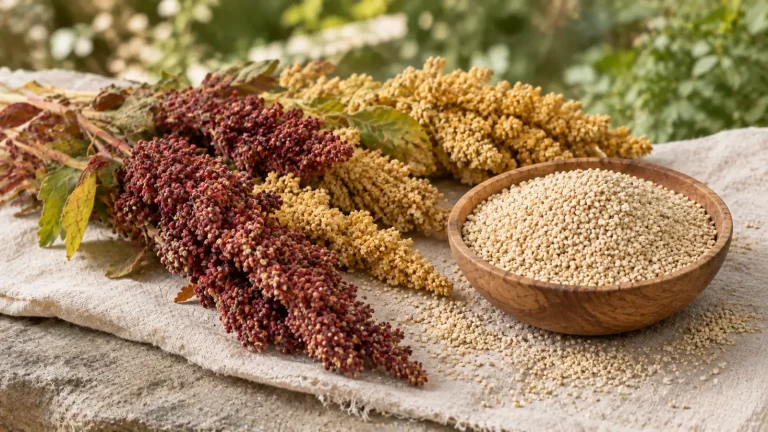
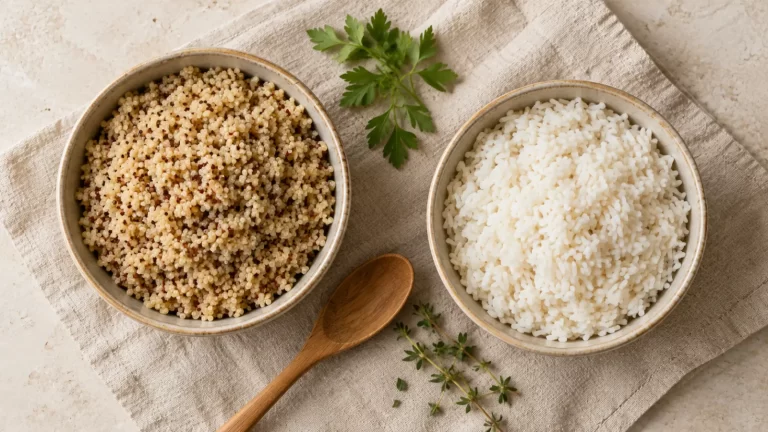
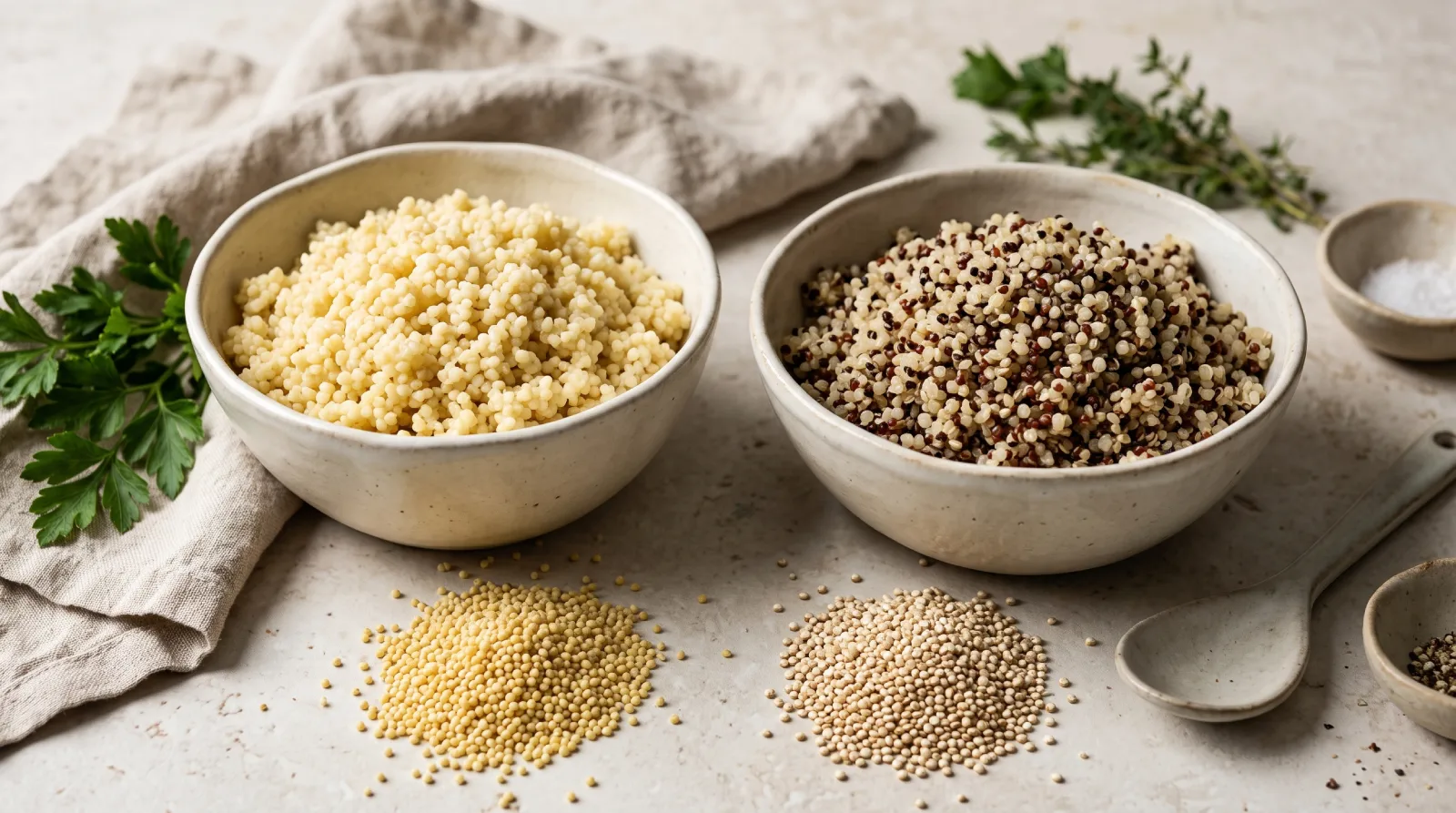
Quinoa isn’t a millet. Millets are grasses (family Poaceae), so they’re true cereals, while quinoa is the seed of a broadleaf plant in the Amaranthaceae family, which is why it’s called a pseudocereal. In a millet vs quinoa comparison, cooked calories are almost equal, but quinoa has more protein and fiber and about 3.5 times the lysine.
Millet vs quinoa at a glance
| Millet | Quinoa | |
|---|---|---|
| What it is | Seeds of several grasses (true cereals) | Seed of a broadleaf plant (pseudocereal) |
| Plant family | Poaceae, the grass family | Amaranthaceae, with spinach and beets |
| How many species | Several: pearl, finger, foxtail, proso and more | One: Chenopodium quinoa |
| Calories, 100 g cooked | 119 kcal | 120 kcal |
| Protein, 100 g cooked | 3.5 g | 4.4 g |
| Fiber, 100 g cooked | 1.3 g | 2.8 g |
| Lysine, 100 g cooked | 0.07 g | 0.24 g |
| Glycemic index | Varies by type and dish (millet porridge: 67) | About 53 |
| Gluten | None | None |
| Cooking, 1 cup dry | 2 cups water, 20 min | 2 cups water, 12 min plus 5–10 min resting |
| Taste and texture | Mild and slightly sweet; soft, creamy if stirred | Nutty and a little earthy; grains stay separate |
Sources: USDA FoodData Central (millet 168871, quinoa 168917); WSU Extension; FAO; GI tables and GI Foundation; University of Arizona (gluten); Oregon State University Extension (cooking). Taste and texture are a general cooking description. Full links below.
Is quinoa a millet?
No. “Millet” is a name for the small-seeded grains of several different grasses. USDA’s record for cooked millet lists its scientific name simply as Poaceae, the grass family that wheat, rice and corn also belong to. That makes millets true cereals.
Quinoa comes from a completely different branch of the plant world. Washington State University Extension places it in the Amaranthaceae family, “along with garden favorites spinach and beets as well as the weed lambsquarters.” Older books file it under Chenopodiaceae, which is now usually treated as part of Amaranthaceae. Quinoa is cooked and eaten like a grain without being a grass, so it’s called a pseudocereal. So millets and quinoa aren’t the same thing, even though they end up in the same kinds of dishes.
Is quinoa the same as korralu (foxtail millet)?
No. Korralu, the Telugu name for foxtail millet, is Setaria italica, a grass. The FAO notes that foxtail millet is widely grown in India, though it was first domesticated in East Asia. Quinoa is a different plant from a different family. The two can stand in for each other in a pilaf or a bowl, but botanically they aren’t related.
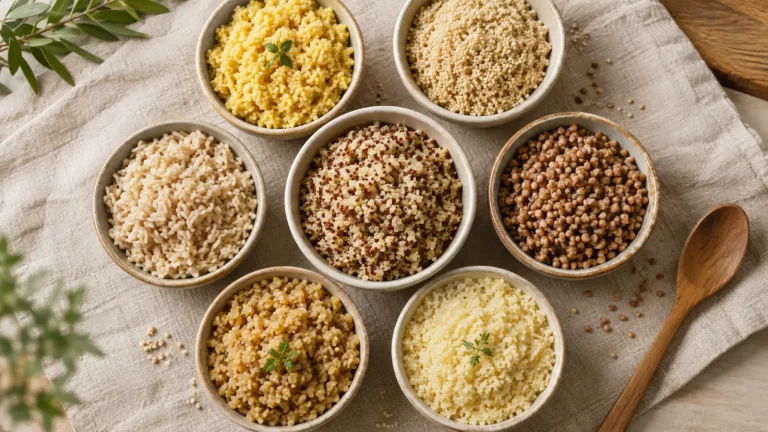
Millet isn’t one grain: the main types
When a recipe or a nutrition label says “millet,” it could mean any of several grasses. These are the main millets listed by the FAO.
| Millet | Scientific name | Other names | Suggested origin |
|---|---|---|---|
| Pearl millet | Pennisetum glaucum | Bajra, cumbu, bulrush millet | Tropical West Africa |
| Finger millet | Eleusine coracana | Ragi, African millet | Uganda or a nearby region |
| Foxtail millet | Setaria italica | Italian or German millet | East Asia (China) |
| Proso millet | Panicum miliaceum | Common millet, broom-corn millet | Central and East Asia |
| Kodo millet | Paspalum scrobiculatum | Kodo | India |
| Little millet | Panicum sumatrense | Little millet | Southeast Asia |
| Barnyard millet | Echinochloa crus-galli | Sawa millet | Japan |
Source: FAO, Sorghum and millets in human nutrition, Table 1.
USDA’s raw millet record is proso millet, Panicum miliaceum; the cooked record used below doesn’t name a species. Ragi, bajra and other millets will have different numbers.
Millet vs quinoa nutrition per 100g
Cooked, the two have almost the same calories. Quinoa comes out ahead on protein, fiber and most minerals. Millet has more niacin.
| Per 100 g, cooked | Millet | Quinoa |
|---|---|---|
| Calories | 119 kcal | 120 kcal |
| Protein | 3.5 g | 4.4 g |
| Carbohydrates | 23.7 g | 21.3 g |
| Fiber | 1.3 g | 2.8 g |
| Fat | 1.0 g | 1.9 g |
| Iron | 0.63 mg | 1.49 mg |
| Magnesium | 44 mg | 64 mg |
| Potassium | 62 mg | 172 mg |
| Manganese | 0.27 mg | 0.63 mg |
| Folate | 19 µg | 42 µg |
| Niacin (B3) | 1.33 mg | 0.41 mg |
Source: USDA FDC 168871 (millet, cooked) and USDA FDC 168917 (quinoa, cooked).
Per cooked cup, the gap holds: about 8.1 g of protein and 5.2 g of fiber for quinoa against about 6.1 g and 2.3 g for millet. For calories by cup size, vitamins and the uncooked values, see quinoa’s full nutrition facts.
Protein quality: the lysine gap
The biggest difference isn’t how much protein each grain has but what that protein is made of. Lysine is an essential amino acid, meaning your body can’t make it. According to the FAO, it’s the most limiting amino acid in millet protein, and in foxtail millet it’s followed by tryptophan and the sulfur amino acids. Quinoa doesn’t have that weak spot. Using the USDA records, we calculated about 54 mg of lysine per gram of protein in quinoa and about 19 mg in millet. Per 100 g cooked, that’s 0.24 g against 0.07 g.
Foxtail millet vs quinoa
USDA’s standard reference data has no entry for foxtail millet, so we used the FAO’s composition table for the raw grain and set it beside USDA’s uncooked quinoa.
| Per 100 g, raw | Foxtail millet | Quinoa, uncooked |
|---|---|---|
| Energy | 351 kcal | 368 kcal |
| Protein | 11.2 g | 14.1 g |
| Fat | 4.0 g | 6.1 g |
| Carbohydrates | 63.2 g | 64.2 g |
| Calcium | 31 mg | 47 mg |
| Iron | 2.8 mg | 4.6 mg |
| Thiamin (B1) | 0.59 mg | 0.36 mg |
| Niacin (B3) | 3.2 mg | 1.5 mg |
Sources: FAO, Sorghum and millets in human nutrition, Table 17 (12% moisture; data from 1980–1984) and USDA FDC 168874.
Treat this as a rough guide. The two columns come from different databases, decades apart. The FAO reports crude fiber, which is measured differently from the dietary fiber on US labels, so we left fiber out. The overall picture still matches the cooked comparison: quinoa is ahead on protein, fat and iron, and foxtail millet on thiamin and niacin.
Glycemic index: millet vs quinoa
Cooked quinoa has a GI of about 53, according to the Glycemic Index Foundation at the University of Sydney. That’s low, since 55 or under counts as low. “Millet” has no single GI because the species and dishes vary so much. In the 2008 international GI tables, millet porridge averages 67 ± 5, which is medium.
So which is better for diabetes, millet or quinoa? We found no study that compared the two head to head. On the available numbers, quinoa has the lower GI, but portion size and the rest of the meal matter at least as much. If you manage diabetes, plan carbohydrate portions with your doctor or dietitian. For another everyday comparison, see whether quinoa or oats suits your breakfast better.
Frequently asked questions
What is a major drawback of millet?
Its protein is low in lysine, so on its own it’s a weaker protein source than quinoa or legumes. The FAO also describes compounds in pearl millet that can affect the thyroid: rats fed pearl millet diets developed thyroid changes, and goiter was more common in rural Sudan, where pearl millet was the only staple, than in towns where other grains were eaten. The FAO adds that more evidence is needed to understand how these compounds act.
Are millet and quinoa gluten-free?
Yes, both are naturally gluten-free. University of Arizona Campus Health lists millet and quinoa among the whole grains allowed on a gluten-free diet. Gluten-free grains can pick up traces of wheat in fields, mills or shared bulk bins, though. If you have celiac disease, buy packs labeled certified gluten-free and avoid scooping from shared bins.
Which millet is closest to quinoa?
None matches quinoa’s lysine. On raw protein, proso millet (12.5 g per 100 g in the FAO table, 11.0 g in USDA’s), pearl millet (11.8 g) and foxtail millet (11.2 g) come nearest to quinoa’s 14.1 g. In the kitchen, they’re closer. The FAO notes that hulled millet is sometimes boiled and served like rice, which is how you’d use quinoa in bowls, pilafs and salads.
Is millet the healthiest grain?
No single grain holds that title. Millet is a gluten-free whole grain with more niacin than quinoa. Per 100 g cooked, though, it has less protein, lysine, fiber, iron, magnesium and potassium, as the tables above show. The better choice depends on what the grain has to do in your meal.
Can I use millet instead of quinoa?
Yes, in most savory dishes. Oregon State University Extension cooks both in 2 cups of water per cup of grain: millet simmers for 20 minutes, quinoa for 12 plus 5 to 10 minutes’ rest, and each makes about 3 cups. Expect a little less protein and fiber per serving. The same swap logic applies to wheat-based options, as in our comparison of quinoa and bulgur wheat, and there are other good swaps for quinoa too.
Shop Peruvian quinoa flour
We don’t sell millet, but we do sell quinoa as Peruvian quinoa flour, bought in Peru and shipped from Lima.
- Best seller

Sources
- USDA Agricultural Research Service, 2019. Millet, cooked (FDC 168871); Millet, raw (169702); Quinoa, cooked (168917); Quinoa, uncooked (168874). FoodData Central, SR Legacy.
- FAO, 1995. Sorghum and millets in human nutrition. FAO Food and Nutrition Series No. 27, Rome.
- Kellogg JA, Murphy KM, 2017. Grains: Growing quinoa in home gardens. Washington State University Extension, FS258E.
- Atkinson FS, Foster-Powell K, Brand-Miller JC, 2008. International tables of glycemic index and glycemic load values: 2008. Diabetes Care 31(12):2281–2283; and Glycemic Index Foundation, University of Sydney, FAQs, glycemicindex.com.
- Oregon State University Extension Service, Food Hero, 2022. Cook whole grains on the stovetop.
- University of Arizona Campus Health, 2014. Celiac disease and your gluten free diet.