The short answer
There’s no research on ashwagandha and maca together, so the benefits claimed for the pair come from separate studies of each herb. Ashwagandha has small trials for stress, sleep and testosterone; maca has limited trials for sexual desire. Ashwagandha also has rare but serious liver-injury reports, so talk to a doctor before combining them.
Ashwagandha and maca at a glance
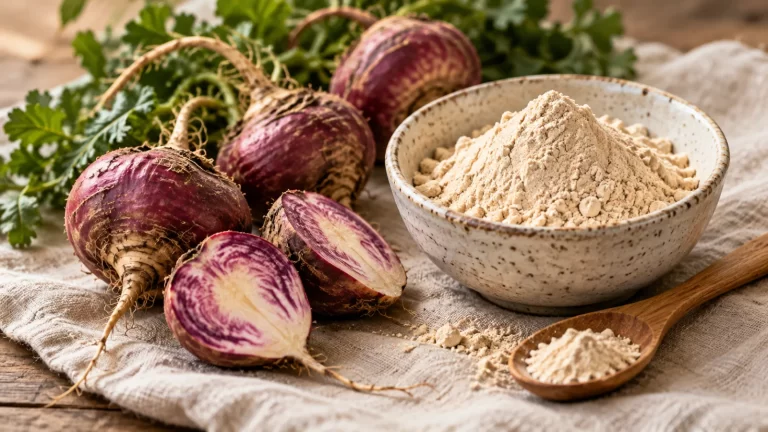
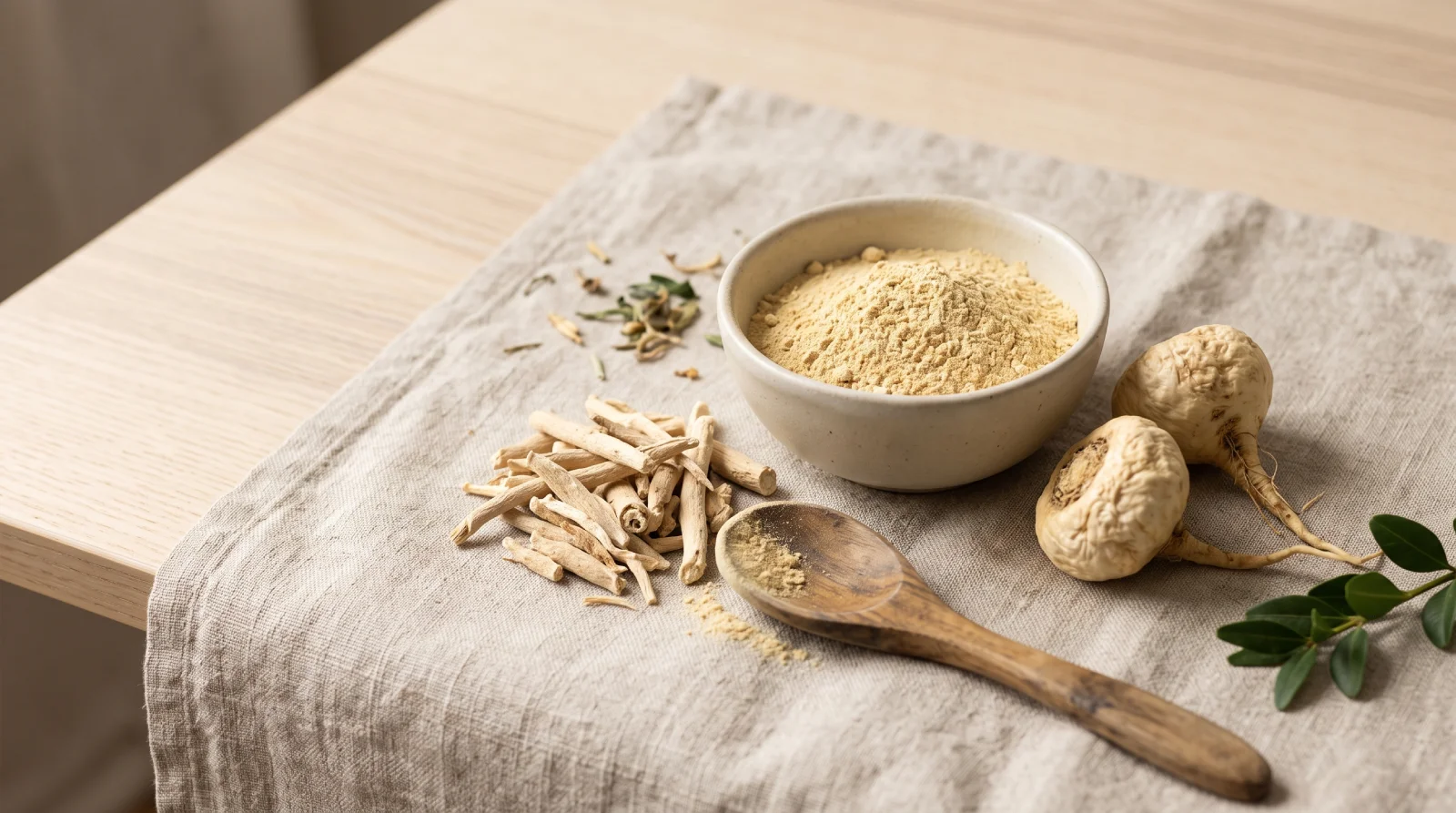
The two herbs have little in common beyond the shelf they share. Ashwagandha (Withania somnifera) is an evergreen shrub grown in Asia, Africa and Europe, and most supplements use an extract of its root, according to the NIH Office of Dietary Supplements. Maca (Lepidium meyenii) is an Andean root that Peruvians eat as a food. It is made up mainly of carbohydrates and protein (LiverTox), and outside Peru it’s mostly sold as dried maca powder.
| Ashwagandha | Maca | |
|---|---|---|
| What it is | Evergreen shrub from Asia, Africa and Europe | Root of an Andean plant, eaten as food in Peru |
| Form used in studies | Root extract | Root powder or extract |
| Amounts in studies | 240 to 1,250 mg of extract a day | 1.5 to 3.5 g a day |
| Best studied for | Stress, anxiety and sleep | Sexual desire, mood and energy |
| Main safety concerns | Rare liver injury, thyroid effects, pregnancy | Few reported; mostly stomach upset and headache |
| Tested together with the other? | No | No |
Sources: NIH Office of Dietary Supplements 2025; LiverTox 2019 and 2024; Shin 2010.
If you’re choosing between them rather than combining them, we compare how ashwagandha and maca stack up side by side.
Can you take ashwagandha and maca together?
Plenty of people do, and some brands sell both in one capsule. But nobody has tested whether the pair is safe, or whether it does more than either herb alone. As of October 2026, a PubMed search turns up no trial that tested maca and ashwagandha together. Every “synergy” claim you read is a guess built from separate studies.
You’ll often see the line “no known interactions.” That mostly means nobody has looked. Mixed products add another layer of doubt: LiverTox points out that commercial herbal products are often blends, sometimes mislabeled, so when a side effect shows up it can be hard to say which ingredient caused it. Each extra herb, such as the fenugreek in some stacks, adds its own unknowns; see what happens when fenugreek joins the mix.
If you still want to try both, the careful route is to check with your doctor first and start one herb at a time, so you can tell which one is behind any change. Read the safety section below before you start.
What ashwagandha has shown in studies
The NIH Office of Dietary Supplements describes most ashwagandha studies as fairly small and short. Here is what they found.
Stress and anxiety
A 2021 systematic review, summarized by the Office of Dietary Supplements, included 7 studies in 491 adults who took 240 to 1,250 mg of extract a day for 6 to 8 weeks. Stress and anxiety scores fell more than with placebo, and the effect looked larger at 500 to 600 mg a day. Not every trial agrees: in a 12-week trial of 120 people, ashwagandha didn’t lower perceived stress, though it did reduce fatigue.
Sleep
A 2021 meta-analysis of 5 studies in 372 adults, taking 250 to 600 mg a day, found a small but significant improvement in sleep compared with placebo. The effect was larger at 600 mg a day, after 8 weeks or more, and in people with insomnia.
Testosterone in men
A 2021 systematic review of 32 trials of 13 herbs in men found that ashwagandha root and root-and-leaf extracts had positive effects on testosterone levels. The authors flagged small samples and a wide mix of extracts and doses, and said more research is needed before firm conclusions on efficacy and safety.
What maca has shown in studies
Maca has fewer trials than ashwagandha, and they mostly measured sexual function, mood and energy rather than stress or sleep.
Sexual desire
A 2010 systematic review found four small randomized trials with 131 people in total. Maca beat placebo on sexual desire in healthy men, on sexual function scores in healthy postmenopausal women, and on erection scores in men with mild erectile dysfunction. A fourth trial, in male cyclists, found no difference. The reviewers called the evidence “limited” and too thin for firm conclusions.
Mood and energy
In a 12-week trial in Peru, 175 adults took 3 g a day of red or black maca extract, or a placebo. Near sea level, both extracts improved self-rated mood and energy more than placebo. At 4,340 meters, energy didn’t differ between groups. The extract was concentrated: about 20 g of dried root makes almost 3 g of it.
LiverTox puts it plainly for maca as a whole: rigorously controlled trials in people haven’t proven any of the effects claimed for it.
Ashwagandha and maca together benefits: claimed vs tested
Brand pages pitch the pair as one way to cover stress, energy, hormones and libido at once. Here is each claim next to what has actually been studied.
| Claim | Ashwagandha alone | Maca alone | Tested together? |
|---|---|---|---|
| Lower stress and anxiety | Some benefit in small trials | Not well studied | No |
| Better sleep | Small effect across 5 trials | Not well studied | No |
| Higher testosterone | Positive effects in trials in men | No change in hormone levels in a study of 56 men | No |
| Sexual desire | Not covered in the NIH fact sheet | Limited evidence from 4 small trials | No |
| Mood and energy | Less fatigue in one 12-week trial | Better than placebo near sea level in one trial | No |
Sources: NIH Office of Dietary Supplements 2025; Smith 2021; LiverTox 2019; Shin 2010; Gonzales-Arimborgo 2016.
The “stack” pitch adds the two middle columns together and assumes the effects simply add up, with no new risks. Neither part of that has been tested.
For men and for women
Ashwagandha and maca for men
The case for men rests on two separate findings: ashwagandha extracts raised testosterone in the trials covered by the 2021 review, and maca improved sexual desire in a trial of 57 healthy men within the 2010 review. The two don’t seem to work the same way: LiverTox lists a study of 56 men in which maca didn’t change sex or pituitary hormone levels. One caution for men: the Office of Dietary Supplements says ashwagandha might not be safe for men with hormone-sensitive prostate cancer.
Ashwagandha and maca for women
There’s even less to go on. The maca review included one trial in healthy postmenopausal women with better sexual function scores than placebo, and the Peru trial included women as well as men. No trial has tested the combination in women. Ashwagandha can affect the thyroid (more below), which matters if you have a thyroid condition, and the pregnancy warnings are in the safety section.
Black maca and ashwagandha
Black maca is the same plant as yellow maca, with a dark root. No study has paired it with ashwagandha either, so black maca and ashwagandha together carry the same unknowns as any other maca. On its own, black maca extract at 3 g a day improved self-rated mood and energy near sea level in the 12-week Peru trial, with no serious side effects. Much of the rest of the black maca research was done in animals, and we go through it in what the research says about black maca. If you’re also thinking of mixing maca colors, see taking red and black maca together.
Amounts used in studies
These are the amounts researchers gave, not a dose to follow. Ashwagandha is studied as a concentrated extract measured in milligrams; maca as a powder or extract measured in grams. The numbers aren’t comparable, and no one has tested a combined dose.
| Herb | Form | Amount a day | Length | What was measured |
|---|---|---|---|---|
| Ashwagandha | Root extract | 240 to 1,250 mg | 6 to 8 weeks | Stress and anxiety |
| Ashwagandha | Extract | 250 to 600 mg | 6 to 12 weeks | Sleep |
| Maca | Powder or extract | 1.5 to 3.5 g | 2 to 12 weeks | Sexual function |
| Red or black maca | Spray-dried extract | 3 g | 12 weeks | Mood, energy, quality of life |
| Ashwagandha with maca | None | Never tested | None | None |
Sources: NIH Office of Dietary Supplements 2025; Shin 2010; Gonzales-Arimborgo 2016.
The Office of Dietary Supplements says ashwagandha seems well tolerated for up to about 3 months, and its long-term safety is not known.
Side effects and who should avoid the combination
Ashwagandha’s common side effects, such as loose stools, nausea and drowsiness, are usually mild. Maca’s side effects are uncommon and mild too, mostly stomach upset and headaches, according to LiverTox. The bigger questions are about ashwagandha.
Ashwagandha and your liver
LiverTox, the NIH database on liver injury from drugs and supplements, rates ashwagandha a likely cause of liver injury. It’s rare. When it happens, it usually shows up 2 to 12 weeks after starting, with jaundice (yellow skin or eyes) and itching, and most cases clear within 1 to 4 months of stopping. A few cases have been fatal or needed an emergency liver transplant, mostly in people with existing liver disease. LiverTox says people with cirrhosis or advanced chronic liver disease should avoid it. For maca, LiverTox finds no convincing reports of liver injury.
Thyroid, hormones and medicines
Ashwagandha might affect thyroid function, and it may interact with thyroid hormone medicine, diabetes and blood pressure drugs, immunosuppressants and sedatives (NIH Office of Dietary Supplements). Adding maca doesn’t remove any of those concerns, and no one has checked whether it changes them.
Pregnancy, breastfeeding and health conditions
Some experts advise against ashwagandha during pregnancy. Denmark banned it in 2023, and France’s food safety agency advises against it for pregnant and breastfeeding women and for people with hormone (endocrine) disorders, the Office of Dietary Supplements reports. There isn’t enough safety data on maca in pregnancy either. If you’re pregnant, breastfeeding, taking prescription medicine or living with a health condition, don’t start this combination without talking to your doctor.
Frequently asked questions
Is it okay to take maca and ashwagandha every day?
The trials gave each herb daily, ashwagandha for 6 to 12 weeks and maca for up to 12 weeks. Ashwagandha looks well tolerated for up to about 3 months, but its long-term safety is unknown, and there are no data at all on taking the two together every day.
What happens to your body when you start taking ashwagandha?
Side effects, when they happen, are usually mild: loose stools, nausea or drowsiness, according to the NIH fact sheet. In the trials, changes in stress and sleep scores were measured after 6 to 12 weeks. If your skin or eyes turn yellow or you start itching in the first few months, stop and see a doctor: those are the signs of the rare liver injury LiverTox describes.
Should you take ashwagandha and maca at the same time of day?
No study has compared timing for either herb in combination, so morning, evening or split schedules are guesses. The more useful choice is the order you start them in. As we note above, starting one herb at a time makes it easier to tell which one is behind a change.
Do ashwagandha and maca help with fertility?
The pair has never been studied for fertility. The NIH fact sheet on ashwagandha doesn’t discuss fertility, and some experts advise against ashwagandha in pregnancy, which matters because you may not know right away that you’re pregnant. If you’re trying for a baby, ask your doctor before you take either herb. For maca on its own, see what’s known about maca and female fertility.
Shop Peruvian maca powder
We sell maca, not ashwagandha. If you use maca as a food, here is the yellow maca powder we buy in Peru, raw or gelatinized as stated on the pack, and ship from Lima.
Sources
- NIH Office of Dietary Supplements, 2025. Ashwagandha: Fact Sheet for Health Professionals. National Institutes of Health.
- National Institute of Diabetes and Digestive and Kidney Diseases, 2024. Ashwagandha. LiverTox: Clinical and Research Information on Drug-Induced Liver Injury.
- National Institute of Diabetes and Digestive and Kidney Diseases, 2019. Maca. LiverTox: Clinical and Research Information on Drug-Induced Liver Injury.
- Smith SJ, Lopresti AL, Teo SYM, Fairchild TJ, 2021. Examining the Effects of Herbs on Testosterone Concentrations in Men: A Systematic Review. Advances in Nutrition.
- Shin BC, Lee MS, Yang EJ, et al., 2010. Maca (L. meyenii) for improving sexual function: a systematic review. BMC Complementary and Alternative Medicine.
- Gonzales-Arimborgo C, Yupanqui I, Montero E, et al., 2016. Acceptability, Safety, and Efficacy of Oral Administration of Extracts of Black or Red Maca (Lepidium meyenii) in Adult Human Subjects: A Randomized, Double-Blind, Placebo-Controlled Study. Pharmaceuticals.